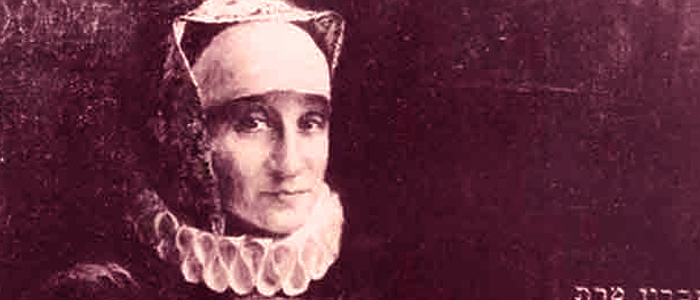
Basya Tsybukmakher
Chapter XII
…The women in the lower gallery were also terribly frightened and rushed downstairs, crowding and pushing one another.
Your mother, dear children, was in her place in the lower gallery, absorbed in prayer. Hearing cries all around me, I asked my neighbour what was happening. She thought that a pregnant woman had been taken ill. Then I became very frightened, because my daughter Esther, sitting six seats away from me, was pregnant too.
I began pushing my way towards her, while she was trying to make her way outside. I called to her, “Where are you going?” She answered, “The roof is falling.”
I put my arms around her and began making a path for us towards the exit.
To leave the lower gallery, one must go down five or six steps. As I struggled through the crowd, I stumbled on the bottom step and lost consciousness. No one came to my aid.
The men hurrying to rescue their female relatives ran past me as I lay motionless and unconscious. Another minute or so, and I would have been trampled to death.
Then someone I knew saw me, helped me stand up and get out into the street. I began shouting and weeping, asking what had happened to my daughter. I was told she had gone home.
I immediately sent someone to see whether she was at home. The messenger returned and said that she had not come back. I began rushing to and fro like a madwoman.
Then my daughter Miriam saw me and, delighted, ran towards me. I asked her, “Where is my Esther?” She answered that Esther was in the house of our brother-in-law Reuven.
His house is not far from the synagogue. I ran there and found my daughter unconscious, without her cloak or head covering. People crowded around her, trying to revive her. Thank G-d, she regained consciousness, and there were no ill consequences for the baby she carried in her womb.
Most of those who died were pregnant too, but they found eternal rest, while we remained here to mourn and weep. Early in the morning on the day after the festival of Shavuot, six new graves appeared in the cemetery: the six women were buried side by side and covered with earth.
Later, the women's section of the synagogue was thoroughly examined, and no defects were found. To this day, we do not know the cause of that terrible crashing.
We must suppose that it was sent because of our sins. Woe to us that we lived to see such a thing! G-d's word was fulfilled: “Upon those of you who remain, I will send faintness into their hearts in the lands of their enemies; the sound of a trembling leaf will pursue them, and they will flee as from a sword and fall when no one pursues them.” To think that this happened on the holy Shabbat, the day on which the holy Torah was given to us, when the L-rd chose us from all the nations. Truly, He “made us a cause of strife to our neighbours, and our enemies mock us.”
We felt as though the Holy Temple had been destroyed in our own days.
Many stories were told about this disaster, but can one describe everything that was said, and can one believe it all?
Frau Esther, the wife of our present teacher, Rabbi Yaakov, was sitting with her five-year-old child at the very top of the staircase. Suddenly, she saw six very tall women whose faces were covered with fluttering veils: they were trampling her as they hurried downstairs. She cried out, “Do you mean to kill me and my child?”
Then they took the child and put the little one in a corner where nothing could cause harm, and hurried on their way. The panic began only when the terrible crash sounded.
This Frau Esther had always been an honest woman and had never once been caught in a lie.
On the night before the catastrophe, the wife of the wealthy Yosef Krumbach, whose house stands beside the synagogue, heard a dreadful noise inside it, as though ruffians had broken in. She woke her husband, and together they sent for the shammes, who unlocked the synagogue. But everything there was in order; not even a piece of plaster had fallen. It remained unknown “on whose account this calamity had befallen us.”
As for me, I think it was punishment for the sins committed on the festival of Simchat Torah.
As is customary on that festival, all the sacred scrolls of the Law had been taken out of the holy Ark, and seven stood on the table.
At that moment, a quarrel broke out among the women. They began tearing one another's veils off, leaving them with uncovered heads in the synagogue. The men joined the fight and fell upon one another. Although the learned Rabbi Avrohom loudly ordered them to stop desecrating the holy day, under threat of excommunication, it was all in vain! Outraged, the rabbi and the community leaders left the synagogue, and afterwards a punishment was imposed on each offender.
Chapter XIII
In the month of Nisan in the year 5479, in 1719, a woman was washing dishes on her knees on the bank of the Moselle. It was late in the evening, but suddenly it became as bright as day. The woman looked up at the sky and saw that the heavens had opened like… [illegible], and sparks flew out. Then the heavens closed again, as if a curtain had been drawn, and it became dark once more. May G-d grant that this be for good and not for ill!