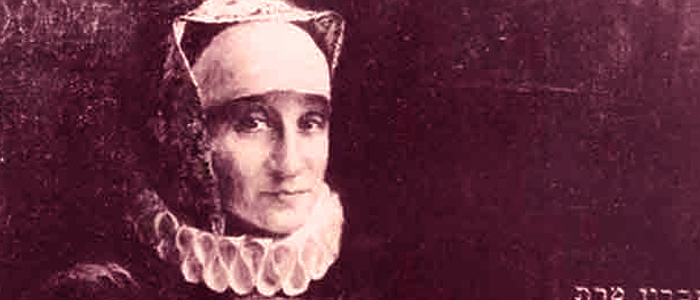
Basya Tsybukmakher
Chapter IX
The community granted the devout Rabbi Gabriel, renowned for his learning—may his light shine!—a year's leave, but nobody imagined that he would not return on time. Yet that year stretched to almost three years!
At the end of three years, the parnasim wrote to him with every respect, saying that he could still return in peace and take up his post as rabbi, for without him the community felt like a flock without a shepherd, and such a community could not exist without a worthy spiritual leader. But in the interests of truth, I must say that Metz had no shortage of capable men, great Talmud scholars and sages. Among them stood out the learned authority in the Law, the honorable Rabbi Aaron Worms, who had been rabbi in Mannheim and its surrounding area for many years, as well as a rabbi in Alsace.
This Rabbi Aaron married his son to Rabbi Gabriel's granddaughter.
Naturally, he was one of Rabbi Gabriel's supporters and maintained that Gabriel would certainly return. Rabbi Aaron was a very wise man, well versed in religious and worldly affairs. His opinion carried great weight, and the community was content to decide to wait a little longer.
Eventually the community learned that Rabbi Gabriel had been nominated for the rabbinical post in Nikolsburg (in the eighteenth century, Nikolsburg in Moravia had one of Central Europe's most flourishing Jewish communities). It is hard to describe the confusion this news caused.
Rabbi Gabriel's son tried to persuade the leaders of the community to wait a little longer. But when they heard that Rabbi Gabriel had allowed his candidacy to be put forward for the rabbinical post in Nikolsburg, the authorities, with the approval of most of the community, resolved to find a new rabbi.
That was when the storm began.
Rabbi Gabriel's supporters, such as Rabbi Aaron and his followers, did everything they could to prevent the appointment of a new rabbi. But soon, at a meeting of all the members of the community, they were required—under threat of a heavy fine—to elect Rabbi Gabriel's successor.
Accordingly, they wrote a letter of invitation to Brod, the chief rabbi of Prague, in the most courteous terms, and sent it by a special courier. Some time later, after amendments to the contract, the aforementioned rabbi agreed to come to Metz.
Whether the highly respected Rabbi Gabriel heard about this, or whether he never doubted for a moment that he ought to return to his post, I cannot say. In any case, he returned without delay and, relying on the support of his followers, announced that he was ready to resume his duties as rabbi.
I dare not describe what followed.
Forgive us, O L-rd, each and every one of us, for our sins! It is not for me, a simple and unlearned woman, to write about such matters! May G-d forgive everyone for what was done in the heat of anger, in haste. Yet what both parties did to insist on their own way would fill a whole book. As for me, I pray to the L-rd our G-d to grant us the virtue and piety of both these sages.
After Rabbi Gabriel had spent some time here and had become convinced that nothing could be changed, and that the community's leaders would not withdraw their invitation to Rabbi Abraham Brod, who had already accepted it, Rabbi Gabriel left again. He departed the city with honor, because everyone in the community was his friend.