Sarah Yocheved Rigler
On Sarah Appel's fifth birthday, her grandfather Yakov gave her a prayer book with an olivewood cover that his father had bought several decades earlier on a pilgrimage from Belarus to Palestine.
On its first page, he wrote: “Always be proud that you are Jewish, and know that you have a Holy Land.”
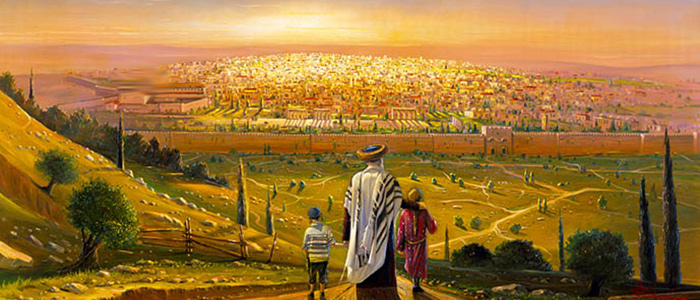
Sarah, who grew up in a non-observant family, could not read Hebrew and did not know how to use the prayer book. She therefore placed the precious gift under her pillow and kept it there for the next seven years. Apparently, the prayer book entered her dreams. Although she lived in Upland, a small town in central California, she often dreamed of a distant Golden City. In one dream that recurred many times, she saw herself walking along a narrow bridge towards the Golden City. Then she heard a voice from Heaven: “If you look only at the light coming from the Golden City, you will reach the Golden City.”
But as she walked along the bridge, she heard other voices coming from below it. There she saw beautiful people, dressed in beautiful clothes and singing beautiful songs. They called to her to join them, but as soon as she moved towards them she fell off the bridge and found herself forever “in the land of everlasting Nowhere, like an empty shopping mall with nothing real inside.”
One day, when she was twelve, Sarah's father announced that he had bought a larger house in a neighbouring town and that they would soon move. Sarah loved her home, especially the large elm in the garden, where she spent hours dreaming of being closer to her Creator. “You may be moving,” she told her father sadly, “but I'm not.”
One night, several weeks later, while Sarah was fast asleep, her father picked her up and put her into the family car. The next morning, she woke up in a different house in a different town. Stunned, Sarah jumped onto her bicycle and rode for half an hour until she reached her old home. A dreadful sight awaited her. A van stood outside, and an unfamiliar family with three sons was moving in. She watched them in anguish. Finally, she got back on her bicycle and rode away.
Beautiful people
The dreams of the Golden City disappeared. Instead of listening to Heaven's voice and concentrating on the light from the Golden City, Sarah answered the siren call of the “beautiful people.” By the time she finished school, the sixties were in full swing. There were plenty of beautiful people: hippies with their loose clothes and soulful songs, followers of meditation with their religion of universality and love, and Native Americans with their exotic culture and connection to nature. The Golden City was forgotten.
In 1965, Sarah was studying art at the University of California, Los Angeles. A non-Jewish friend told her, “I always knew you were Jewish because there is faith in your eyes. Recently, I met a young man who also has faith in his eyes. You should meet him.” The friend introduced her to Dana Fox, a tall young man who had not known he was Jewish until he was eighteen, when someone told a crude Jewish joke in the living room of his home. When Dana laughed, his mother rebuked him: “Don't laugh. You're Jewish too.”
Sarah and Dana discovered that they were an extraordinarily good match. One day, their conversation turned to childhood. Dana said that he had grown up in the small town of Upland. Sarah was astonished.
“I grew up there too, until I was twelve. Which street did you live on?”
“Sixth Street,” Dana answered. “I lived at 554 North Sixth Street.”
Sarah went white. That was her house. Dana was one of the three boys who had moved into her home.
The wedding
In time, Dana and Sarah decided to marry. Sarah's delighted mother arranged a wedding for a Sunday in July at a Reform temple.
On the morning of her wedding day, Sarah woke in panic. She had had a terrifying dream about the Golden City of her childhood. This time, however, the Golden City was burning. All its inhabitants were screaming in terror.
Sarah called Dana and told him, “We can't get married today. I don't know why, but it's a terrible day for a wedding.” When Dana came to see her, he realised that he would not be able to persuade her. But why?
They decided that a rabbi might solve the ominous mystery of her dream. Under “Rabbis, Orthodox” in the Los Angeles telephone directory, they found a name and an address nearby. They quickly drove to the rabbi's house and knocked. When he opened the door, Sarah asked plaintively, “Why can't we get married today?”
The rabbi looked at them and answered: “Because today is Tisha B'Av, the terrible day on which the Holy Temple in Jerusalem was burned.”
Dana, Sarah and the rabbi stood with tears streaming down their cheeks. The rabbi wept because these young Jews had planned to marry on a day of fasting and mourning. Dana wept because this rational explanation meant that he would have to postpone his wedding. Sarah, however, wept for joy: she had finally learned the name of her Golden City — Jerusalem! Suddenly she understood the meaning of all her dreams.
To both families' great dismay, Sarah and Dana postponed their wedding by two days. On Tuesday, the eleventh of Av, the rabbi they had found married them in an Orthodox ceremony. “Our wedding meal was the first kosher food we had ever eaten in our lives,” Sarah recalled many years later.
A miracle in the backyard
Dana and Sarah moved to the San Francisco Bay Area.
They rented a modest house at the foot of a steep hill, with a lovely backyard surrounded by a tall redwood fence. By the summer of 1970, they had two children and Sarah was expecting their third. Dana taught in an elementary school, and Sarah taught art.
One day, Sarah was working in the kitchen. Her two toddlers were playing in a small plastic pool in the backyard.
Suddenly, Sarah heard a voice inside her head commanding: “Run faster! Get the children! Quickly! Right now!”
Sarah dashed into the backyard, scooped up one child in each arm and rushed back into the kitchen. As soon as the door slammed behind her, she heard a deafening crash. Turning around, she saw an enormous semi-trailer truck filling her entire backyard. The redwood fence had been smashed into splinters as though it were made of toothpicks. Beneath the truck's wheels lay the crushed plastic pool.
Leaving the desert
The Foxes' eldest daughter suffered from constant earaches. Their doctor advised them to move to Arizona's dry climate. So, in 1971, the family drove to Arizona in their Volkswagen minibus. There they settled in a trailer on a desert hill beside a steep cliff, among Mormons, Catholics and Native Americans.
Two years later, the Yom Kippur War broke out in Israel. One night, Dana had a nightmare. He shouted, “They won't take my land away from me!” When he woke the next morning, he told Sarah that he wanted to visit the nearest aliyah office to find out about moving to Israel.
Dana, Sarah and their three young children climbed into the Volkswagen minibus and drove to the aliyah office in Phoenix, Arizona's capital. There, a Jewish Agency representative asked whether they had ever been to Israel. They answered, “No.”
“Do you know anything about Israel?” he asked.
“No,” they answered.
“Are you members of a Jewish community?”
“No.”
“Then why do you want to move to Israel?” he asked them, puzzled.
Sarah told him about her olivewood-covered prayer book from Palestine, her dreams of the Golden City and how, on her wedding day, she had understood that it was Jerusalem.
The Jewish Agency representative was visibly moved. In a tone unusual for an Israeli official, he told them, “My children, my children, come home.”
And so they decided to make aliyah. They filled out all the forms and arranged to leave exactly a month later. Then they drove back to their desert home on the cliff.
Sarah was frightened. A war was under way, and at that point Israel was not winning. As she and Dana got out of the Volkswagen minibus, while the children were still playing inside, she told her husband: “If we go to Israel, our lives and our children's lives may be in danger.”
She had barely finished speaking when their minibus, with the three children inside, suddenly began to move. Within seconds it gathered speed and raced downhill at sixty miles — ninety-six kilometres — an hour, heading straight for the cliff. Dana, Sarah and several dozen neighbours froze in horror. Nothing could stop the vehicle. Moments later, it was hanging over the abyss… and suddenly stopped. A rear wheel had caught on a small bush. To everyone's astonishment, the minibus hung in mid-air, held only by the bush.
All their neighbours began shouting: “A miracle for the Jews! G-d has made a miracle for the Jews!”
Everyone rushed to the vehicle and, using ropes, pulled it back onto the road. The children were unharmed.
Sarah and Dana, filled with terror and relief at the same time, returned to their trailer with a Mormon friend. When they entered, a frightening sight greeted them. Dozens of strange black insects were everywhere: on the floor, in the frying pan on the stove, even climbing onto Dana's shoe as they stood there. In two years of living in the desert, they had never seen a single insect like these. “What are they?” Sarah asked her friend.
The friend quickly took a towel and brushed the creature off Dana's shoe. Then she ushered them outside. “These are deadly poisonous scorpions,” she warned. “I've never seen so many scorpions together in my life.”
Sarah and Dana understood that G-d was sending them a clear message. Suddenly, Israel no longer seemed quite so dangerous. “We got the message,” Sarah recalled many years later. They decided then and there to carry out their aliyah plans. That same day, they began selling their furniture. As soon as they sold the first cupboard, the scorpions disappeared. Every last one.
A few months later, the Fox family arrived in Israel. As they descended the aircraft steps, Dana — now Shlomo — said: “We've come home to become Jews again.”
Twenty-eight years later, Shlomo and Sarah Fox-Ashrei have eight children and eighteen grandchildren, all studying Torah and living in Jerusalem. Shlomo and his sons are respected Torah scholars. Sarah has a unique calling.
Every day she spends several hours praying at the Western Wall, undertaking a “forty-day prayer at the Kotel” for people who live too far away to do it themselves.
The still, silent voice
The Almighty is always communicating with people.
Although the messages we receive may be less dramatic than those of the Fox family, most of us experience Divine guidance and providence at some point, through intuition, dreams or a strange convergence of unlikely circumstances.
Most people, especially women, have at some time heard the quiet voice of intuition. Suddenly you think of calling a friend you have not thought about for a long time. You call and discover that she has just experienced a tragedy and is deeply grateful for your call. Or you are deciding whether to book an earlier or a later flight to your nephew's wedding. Something tells you to fly earlier. After landing, you learn that the next flight was cancelled and you would have missed the wedding.
One Friday morning, while preparing for Shabbat, an idea suddenly came to me: “Call Meir and invite him for Shabbat.” Meir was a twenty-five-year-old secular Israeli, the son of my Yemenite cleaner, Etty. Etty had told me that Meir had recently begun showing an interest in Judaism. My rational mind tried to dismiss the idea: “Meir doesn't even know our family. He lives an hour away. There's no way he will want to spend twenty-six consecutive hours with unfamiliar English-speaking ultra-Orthodox people. It's simply ridiculous.” But I heard the whisper again: “Invite Meir.” I called Etty for Meir's number and invited him, and — wonder of wonders — he came for Shabbat!
This began a process that gradually brought Meir to a complete return to religious observance. Today he is married to a graduate of Beit Yaakov, a school for religious girls, and studies full-time in a kollel. From time to time, his proud mother asks me: “What made you call Meir and invite him for Shabbat?”
When can a “message” be trusted?
How can we know that a “message” really comes from the Almighty rather than from our ever-present ventriloquist, the ego?
The Torah explicitly forbids interpreting omens. If you are on a date with a young woman and two white doves circle above your head, you should not take it as a sign that you must marry. The sudden appearance of scorpions in your home is not an omen. Rather, it is an obvious, rational fact: a threat to life. If you were afraid to act in a particular way because of a possible danger, you must now compare that possible danger with the real danger threatening you at this moment. Signs can be interpreted in different ways. “Messages” present facts; we may or may not draw conclusions from them.
From Sarah and Shlomo's story, we can take three clues about when to trust a “message”:
- If the message requires you to do something inconvenient, difficult or downright unpleasant, it probably does not come from your ego. Sarah's message to postpone the wedding brought upon her the anger of her mother, who had spent months planning the event. Dana's dreams about moving to Israel in the middle of a war made him begin a difficult process that ran counter to all his priorities. Rebbetzin Hinda Adler used to say: “If it is difficult, that is a sign that it is good.”
- If you are in doubt, consult a rabbi. Sarah's dream convinced her that the day was unsuitable for a wedding, but she could not understand why. The young couple decided that an Orthodox rabbi could shed light on her dream-message. And he did.
- If the message contradicts the Torah, it is not a message from the Almighty. The Torah is the supreme Divine message: direct and definitive. It contains a specific warning against false prophets. Even if a prophet's predictions come true, or he can perform miracles, if he demands that you do anything contrary to the Torah's instructions, he is unquestionably a false prophet. The same principle applies to every kind of “Divine message.” I believe that since Sinai there has not been a single day on which the Almighty has not communicated indirectly with people. Yet since Sinai there has not been a single Divine message that contradicted the revelation at Sinai.
The more we try to see the Almighty's hand in our lives, the more it will become apparent. And the more we obey His directions, however difficult they may be, the stronger the flow of Divine communication in our daily lives will become. Had Sarah ignored her dream of the burning city, or decided that postponing her wedding was too difficult despite the message, I wonder whether she would have been able to hear the inner voice warning her to save her children.
The key to understanding the Almighty's messages is honesty. If you consider these messages honestly and rationally, without trying to reach a predetermined conclusion; if you seek the advice of a rabbi for whom the Almighty's will takes precedence over his own; and if you are ready to follow even directions that are extremely difficult for you, then you can trust your inner voice. This is what the prophet Elijah called the “still, silent voice” (I Kings 19:12). Divine inspiration is always speaking to us. The more sincerely we listen, the more clearly we hear it.