Sarah Yocheved Rigler
New York City is called the “Big Apple.” Today, New York is a centre of Western civilisation. Ancient Egypt was the “Big Apple” of its time. In technology, art, architecture, literature, wealth and highly organised bureaucracy, Egypt was an unsurpassed civilisation. It had already been developing for many centuries when a small group of seventy Semitic shepherds arrived there about 3,550 years ago.
It is no wonder that the second and third generations of this Semitic family, Yaakov's grandchildren, were captivated by Egyptian society. Its grandeur, power and cosmopolitan character were enough to overwhelm any immigrant child.
Imagine a young Israelite gazing at the imposing line of towering pyramids that began in the Nile Delta and stretched 2,500 kilometres south. The largest, the Great Pyramid of Khufu, rose to a height of 147 metres and had a base covering 53,000 square metres. This monumental structure consisted of 2.3 million limestone blocks, each weighing an average of 2.5 tonnes. Looking at this centuries-old pyramid, our young immigrant would not have known — or cared — that its construction took twenty years of labour by one hundred thousand workers. Who would not want to belong to a society that created such wonders?
And so successive generations of Semites gravitated towards the majority culture, associated with its elite and eventually began worshipping its pantheon of gods.
Yet, as would happen throughout the next three thousand years of our history, these early Jews experienced a conflict of identity. However much they wanted to be part of the fascinating and successful society around them, they also felt loyalty to their ancestors, Avraham, Yitzchak and Yaakov, and to the unique worldview those ancestors upheld. Thus, the Talmud tells us, the Jews in Egypt retained their distinctive Jewish names, language and clothing. Their hearts sought assimilation, but their souls clung to the outward remnants of their ancestral identity.
Who am I?
For more than a century, the Jews in Egypt, as free and prosperous citizens, stood at the junction of two opposing worldviews. It is worth examining the basic differences between them.
Ancient Egypt was a society in which animals, humans and gods formed a single spectrum, with no clear distinctions between them. Many Egyptian gods had animal heads, while sphinxes had lions' bodies and human heads. Sacred animals were revered; in some temples, bulls, cats and crocodiles lived in luxury and were mummified after death. Egyptian peasants shared their huts with their livestock. Pharaoh was both a human king and a deified being.
How radically this differed from the worldview of the patriarch Avraham! Avraham believed in the Divine soul that distinguishes humans from animals. G-d, Avraham taught, is one transcendent, incorporeal Being who created human beings with a Divine element, a Divine soul. Therefore, every person was to be valued. Animals, although they were not to be treated cruelly, were fundamentally different from humans, lacking a soul of that higher order. While bestiality was widespread in the ancient Near East, the Jewish Torah categorically forbade it.
This is no minor distinction. The Torah relates that the first human beings were vegetarians. Only after human society had degenerated, after unrestrained violence and sexual immorality had appeared and led to the Great Flood, did the Almighty permit Noah and his descendants to eat meat. According to the Sages, this was a deliberate step intended to make people feel their fundamental difference from animals.
Civilisations that minimised this distinction ultimately always valued animals and devalued human beings. The best-known modern example is Nazi Germany. Hitler was a vegetarian, and in the midst of the Holocaust Germany maintained an animal protection society that carefully rescued pets left behind when their Jewish owners were sent to slaughter.
Morality and magic
While Avraham's G-d gave us a firmly established standard of good and evil and required us to behave accordingly, Egyptian society was essentially amoral. It had no codified or written laws at all. Pharaoh's arbitrary decisions were the law of the land. Egyptian courts were merely Pharaoh's representatives, carrying out his whims.
An integral part of the Jewish conception of the soul is its capacity to choose. Morality was a new concept that Jews brought into the ancient world. Although ancient Mesopotamia, unlike Egypt, produced many legal codes, they were more utilitarian than ethical. Their purpose was to protect property rights and keep society functioning effectively. Under such codes, murder was forbidden because a society in which murders occur descends into chaos. Under the Torah, murder is forbidden because a human being is created in the image and likeness of the Almighty: human life possesses its own inherent value.
Ancient Egyptian religion was belief in many gods. Its rituals were magical rites intended to alter reality. Avraham insisted that there is only one G-d, who governs the world and is Himself in no sense subject to it. Avraham's G-d can be approached with reverence and love. Avraham effectively entered into a mutual Covenant with the Almighty. He promised to fulfil His will — for example, through circumcision — and the Almighty promised Avraham's descendants special providence and the inheritance of the land of Canaan.
Champions of civic duty
The Jews' wavering between two conflicting identities ended dramatically 130 years after they had arrived in Egypt. The ruling Pharaoh of the Nineteenth Dynasty of the New Kingdom decided that the Jews were becoming too numerous and posed a fifth-column danger in wartime. He decided to enslave them.
The Midrash relates that the process of enslavement was gradual and unobtrusive. First, Pharaoh played upon their patriotism and loyalty to Egypt, calling on them to volunteer for a national building project. All the Jews except the tribe of Levi enthusiastically took part in this civic duty. Gradually, volunteering became compulsory labour and, finally, slavery.
Slavery exposed the dark side of Egyptian civilisation. The magnificent monuments that the Jews themselves admired had been built through exploitation and torture. Pharaoh, alarmed by astrologers' predictions of a Jewish redeemer, ordered male infants to be thrown into the jaws of the Nile's crocodiles. Unrestrained by any ethical imperatives, the overseers were cruel sadists.
It is almost unbelievable, but the Jews' infatuation with the surrounding society was so strong that, according to the Sages, even in the midst of the redemption, during the ninth of the ten plagues, about eighty per cent refused to leave Egypt. The life of a slave within the world's greatest civilisation appealed to them more than an unsafe journey to their ancestors' ancient homeland. Even in the desert, after liberation, many former slaves longed for Egypt's comforts.
The exile of identity
Jewish history is a recurring process of exile and redemption. The first exile, Egypt, is considered the prototype of four later exiles: Babylonian, Persian, Greek and Roman — the last of which continues to this day.
We think that “exile” means banishment from one's own land to a foreign one, and that was indeed true of three of the four exiles listed above. The Greek exile, however, took place while the Jews were living in Judea. In what sense, then, was it an “exile”?
The Greek exile was an exile of consciousness and identity. Living in their own country, many Jews and almost the entire upper class decided to redefine themselves as Hellenists, admirers of the dominant Greek culture and philosophy. Greek culture, like Egyptian culture a millennium earlier, attracted Jews with its art, scientific achievements and cultural sophistication. Like their ancestors in Egypt, the Jews of the Greek period thought they could juggle two national identities. Yet when two identities come into conflict, ultimately only one wins.
Every Jew alive today descends from people who, despite all their trials, chose Jewish faith and identity. Two millennia ago, there were about 4.5 million Jews in the world, representing 1.8 per cent of the world's population. Today there are about 12.8 million Jews, just 0.2 per cent of the world's population. This decline in the Jewish share of the world's population is explained not only by continual persecution and mass murder, but also by the departure of Jews who chose the culture of the people around them. Every Jew reading this essay descends from Jews who repeatedly chose to regard themselves as Jews rather than Egyptians, Persians, Greeks, Christians, Muslims or cosmopolitan atheists.
Jewish identity is like gold. Gold is almost always found mixed with other substances. There are two main ways to extract it from ore. The first, traditional method is to stir the ore with water and allow the heavier gold to settle to the bottom. The more effective modern method is to crush the rock containing the gold and then dissolve it in mercury or cyanide solutions. The surrounding material dissolves, and the gold is extracted.
Jewish self-awareness can be restored in both ways. In Jewish tradition, water is a metaphor for Torah. When a Jew connects with Torah, their Jewish identity separates from the amalgam that held it captive.
The more extreme but effective method, like crushing stone and dissolving it in a toxic solution, is antisemitism, which exposes the dark side of the majority peoples' “civilisation.” The Maharal says that to understand who you want to be, you must first determine who you do not want to be. Egyptian slavery taught those Jews who were willing to learn that they did not want to resemble Egyptians. Rebbetzin Tziporah Heller observes that before 1933, the overwhelming majority of German Jews who had not yet converted to Christianity wanted to be “Germans of the Mosaic faith.” But after the Holocaust, no Goethe, Beethoven or Kant could draw Jews towards identifying with the German people.
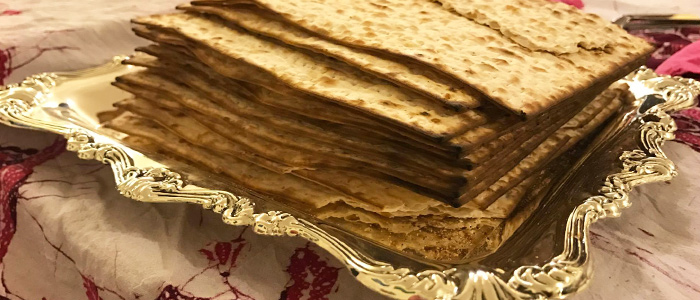
Passover is the redemption of one's own identity, the extraction of gold from ore. The Seder is the defining moment when each of us must arrive at the understanding that our Jewish identity, our Covenant with the Almighty, should become the central element of our self-awareness.
The Haggadah speaks of the “four sons.” The wicked son asks, “What is this service to you?” The Haggadah answers: “To you, and not to him. Because he excluded himself from the [Jewish] community, he denied the Almighty.” He is called wicked not because of his actions, but because he refused to be a Jew.
The brilliant light of redemption that first shone into the world during the Exodus is available every year at Passover. It is a gift from Above. All we need to do is want to receive it. All we need to do is discover who we truly are.