Rebbetzin Yemima Mizrahi
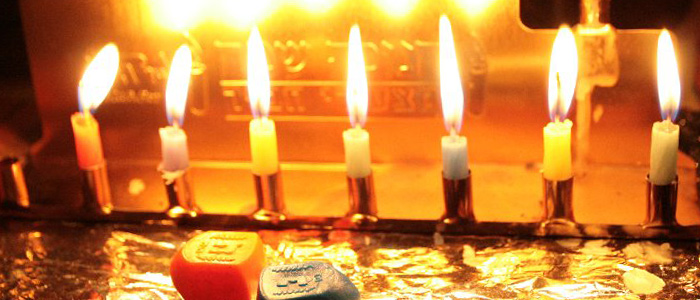
How can we make our family happy, and what does it mean to be a good mother? The hanukkiah can reveal these secrets to us.
The candles standing together in a row, with the shamash at their head, are just like children with their mother leading them.
The first secret of the hanukkiah is to give light to all our children, without exception.
Believe me: even the smallest effort will come back to you a hundredfold. Never forget that you are the shamash of your family. And when you give light to others, you do not lose or diminish even a little of your own light.
When putting a child to bed, do not say, “It's already late, and I'm so tired. You want another story? No, I can't,” or, “I have no energy left, and now I have to make lunch again.” In fact, these things can give us strength rather than drain it, if we find the right way of looking at them.
King Solomon tells us in Proverbs (10:1): “A wise son gladdens his father, but a foolish son is his mother's sorrow.”
When you see a family where one son has a reputation for being “foolish” and is contrasted with a “wise” son who has chosen the right path in life, the image of their sorrowful mother is already in the background.
Yes, that very mother who feels so empty. When she gives her children her energy reluctantly and without enthusiasm, she loses far more than she receives.
But when a mother's face shines—and yes, I know how difficult that can be!—her children's faces will shine too, reflecting her selfless love.
The second secret of the Hanukkah candles is also found in the weekly Torah portions we read during Hanukkah. Our forefather Jacob had to learn this lesson through his own bitter experience: all the candles must be at the same level. If one candle is too high and another much lower, that hanukkiah is not suitable for fulfilling the mitzvah.
Our sages warn that parents must not have “favorites” in the family: all children should be treated with equal warmth.
Recently my daughter, a fifth-grade homeroom teacher, showed me questionnaires her pupils had filled out. Each girl had to write the names of three classmates she liked and, alongside them, three others she disliked and would not want to be on the same team with during the new school year.
Do you know what emerged? Surprisingly, many pupils appeared on neither list. I call these children “invisible”; they are “transparent.” Nobody particularly notices whether they have been at school or not. How sad that is!
The saddest thing is that this happens in families too.
For example, a “sandwich” child: the older and younger siblings shine, while the child between them risks becoming a wooden doll, deprived of warmth and love.
Dear mother, be that child's mother too. That child feels left out, “invisible,” and unwanted!
The third secret the hanukkiah can teach us:
Unlike Shabbat candles, each Hanukkah candle has its own day of the festival, a sort of “birthday.” Likewise, every one of our children certainly deserves attention and special time devoted specifically to them. The only way to distribute your motherly attention properly is to understand that each of your children is unique in their own way.
Do not put off this task: find the light in each of your children…
As the hanukkiah glows with little flames, we often see that the candles burn differently: one burns faster, another suddenly starts dripping, and a third has the tallest flame. Every child has their own path. As you put your heart into all your children, rejoice in and appreciate the uniqueness of each path—their own special path!
And finally, the fourth secret of the hanukkiah, the most important one: “Ve'ein lanu reshut lehishtamesh bahem”—we have no right to use a child.
Since when have children become “machines” for producing parental pleasure, nachas? We cannot use them to improve our reputation, boost our self-esteem, or create a favorable image for ourselves in society.
It hurts to watch a child choose a different path from the one you would have wished for them. It really is hard.
But if the source of the parents' pain is irritation, frustration, or even anger because the child is “spoiling” the family's good name, the child will sense your attitude. At that moment, they need to feel loved more than ever!
Your duty, mother, is to stand before the Hanukkah candles and ask for a miracle to happen this year.
Rabbi Chaim Vital says that during the year we are forbidden to ask for a miracle, because if G-d grants our request, it will come at the expense of our future reward in Heaven. But there is one exception: Hanukkah. Since the essence of Hanukkah is the manifestation of miracles, it is the only time of year when we can pray for miracles and expect them to occur.