Sarah Yocheved Rigler
“You're so lucky,” Shani told me. “You're a ba'alat teshuvah, you've practiced meditation, and you have a close relationship with the Almighty. I've kept the commandments all my life. For me, they're a dry routine. I don't feel close.”
Whenever I hear this mournful confession, I feel as though I am sitting in the passenger seat of a luxurious new car whose driver does not know how to use half its advanced features.
Could a religion that produced righteous figures such as King David, the medieval poet Yehudah Halevi, the Kabbalists of Tzfat, the Baal Shem Tov and the women who pray daily at the Western Wall lack a path to closeness with the Almighty?
Can a religion that inspired the Song of Songs and Yedid Nefesh be called dry? “Glorious, beautiful, radiance of the universe, my soul longs for Your love…”
What is missing here?
Unity of will
The highest union with G-d that human beings can attain is a union of will. From a Kabbalistic perspective, Keter, the highest of the ten sefirot, is characterized by joy, faith and will. Uniting our will with the Divine will is the ultimate closeness to G-d.
Even in human relationships, true love involves joining wills, often requiring us to submit our own will to that of the beloved. This is why real love, unlike Hollywood love, requires hard work and even giving things up. If you want an Italian restaurant and your spouse wants a Chinese one, unity will be achieved only if one of you loves the other enough to say sincerely, “Let's do what you want. I don't mind.”
From this perspective, the greatest obstacle in a relationship is not knowing what the other person wants.
This problem arises in our family every year on my husband's birthday. My desire to give him what he wants is frustrated by his not wanting anything in particular.
This year was different. Two weeks before his birthday, my question about a gift received an unambiguous answer. He wanted the famous four-volume work on the laws of Shabbat, in English. Delighted, I went to our local Jewish bookshop and asked for it.
The book was out of print. The owner assured me that there was not a single copy anywhere in Jerusalem, but the publisher was preparing a new edition that, with luck, would appear in a month or two. Words cannot describe my disappointment.
The day before his birthday, I was shopping in Geulah. Suddenly I noticed that I was standing near a bookshop. Firmly believing that it never hurts to try, I went in and asked for the four-volume work on Shabbat laws.
The Hasidic owner replied, “I have the very last copy in all Jerusalem. Someone ordered it several months ago and I've held it all this time, but he never came back from America. So I'm willing to sell it to you.”
Overjoyed, I bought the enormous books and headed to meet my husband, who was collecting me by car. We had agreed he would wait at the top of Strauss Street, about four blocks away. It was hot, and I was already carrying half a dozen heavy bags. The four volumes weighed about five kilograms, but as I climbed the hill I was thrilled that I could give my husband exactly what he wanted.
In the Torah, the Almighty tells the Jewish people precisely what He wants from us. We are not “weighed down by the burden of commandments.” We have a great privilege: 613 ways to connect with the Almighty. No greater expression of His love exists than the commandments, 613 channels of complete connection.
Second base
When religious Jews complain that they do not feel connected to the Almighty while performing commandments, they acknowledge their own deficiency, not one in the Torah.
The feeling of connection they find elusive does not come automatically. The pitfall of observing Jewish law is how easy it is to slip into mechanical performance. Let me rephrase that. It is difficult not to perform mechanically commandments repeated daily, sometimes many times a day. Doing them as they should be done—consciously, joyfully, focused on the One Who commanded them—is an achievement requiring continual effort and a degree of concentration that could challenge a brain surgeon.
Rabbi Shlomo Wolbe wrote, “Obviously, mechanical performance of commandments contains neither awareness, love nor joy.”
What does Rabbi Wolbe recommend as the antidote? Do not jump suddenly into a mitzvah. Instead, “Let us reflect that the Holy One, blessed be He, Himself commanded us to perform this mitzvah, and that through it we connect with Him” (Alei Shur, p. 327).
We are busy all our lives. Nobody manages to do everything, and do it all properly. Most of us perform commandments—praying, blessing food and so on—like a baseball player who must touch second base with at least a finger before racing toward third. We consider it praiseworthy that we find any time for commandments at all. The thought of taking an extra couple of minutes beforehand to pause, consider Who commanded them and unite our will with His fills us with trepidation. It is incredibly difficult! But this is how commandments should be performed.
For example, the Rambam writes that before reciting the Amidah, a person must stop and consider the greatness of G-d, Whom they are about to address. Since the average Jew takes five to fifteen minutes to recite it, is it not a shame to omit two extra minutes of reflection beforehand that could reshape the whole prayer into an exercise in love and closeness?
Separating challah
I have been observing Torah law for eighteen years.
Three months ago, a woman named Rachel Miller began a course in our neighborhood on the mitzvah of separating challah. In the Torah, the Almighty commands us that, upon entering the Land of Israel, when baking bread and other products from a non-liquid dough, we must separate a small piece of dough and set it aside. This is one of the three commandments given especially to women, although men are by no means exempt.
Not being a great cooking enthusiast, I had never been inclined to bake bread from scratch. With my breadmaker, yes. With my pianist husband, who enjoys exercising his fingers by kneading dough, yes. I simply recite the blessing and break off a piece of dough. But a ten-week course on a single commandment, separating challah? No, thank you.
When a friend asked why I was not taking the challah course, I replied lightly that I did not like baking bread. She looked at me indignantly. “Don't you know that all blessings of physical abundance descend into the world through the mitzvah of separating challah? This commandment also brings healing in fourteen different ways.”
I enrolled, wondering how there could be so much to say about one commandment.
“The mitzvah of challah has cosmic significance,” Mrs. Miller declared. Each week, I grew more astonished as she described its profound consequences.
Then she announced that Rabbi Elazar Barclay would visit the following week to explain its halachic details. The session would last two hours.
Two hours? I could not imagine how he would fill two hours with information about separating challah. Surely I already knew how to perform the mitzvah.
But I went to the class anyway. I discovered that I had been performing it incorrectly.
The following week, Mrs. Miller announced a challah-baking demonstration. I came expecting a cooking lesson I would not need, because my husband had the world's best wholegrain challah recipe.
The baking demonstration became a life-changing event.
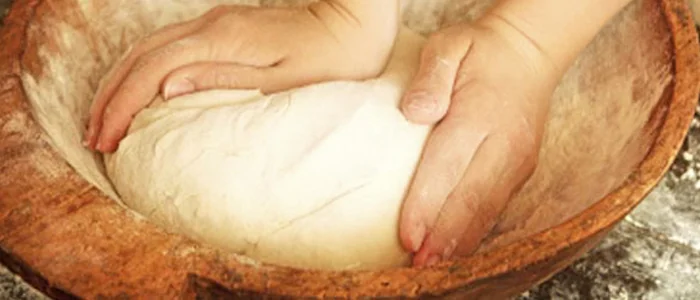
Now I bake challah once a month, and it is the month's spiritual high point. I begin by switching off the phone and announcing that nobody may enter the kitchen until I finish; this mitzvah requires complete concentration. Then I give tzedakah, charity, so that all my prayers will be favorably received. I recite a chapter of Tehillim, Psalms, to open the gates of Heaven. As I sift the flour, I sing, because joy underlies every spiritual success. I add each ingredient consciously: sugar for the sweetness I hope to see in my family's life; yeast so that each family member will grow; water, symbolizing Torah. As I measure the salt, symbolizing rebuke, I pour two tablespoons and then shake a little back into the salt container, because we should always rebuke less than we think necessary. Slowly pouring in the oil, I “anoint” each family member by name, praying for their particular needs.
Kneading is a time for prayer. My teenage daughter, Pliya Esther, and I take turns naming people to pray for: single friends, that they marry; childless couples, that they have children; the sick and victims of terror, for a speedy and complete recovery; those in financial difficulty, for a livelihood; and those experiencing marital conflict, for peace at home. Pliya Esther reminds me to add the names of Israel's missing soldiers and Jonathan Pollard, who was eventually released from prison by the Americans and allowed to immigrate to Israel. We keep kneading and praying with such spiritual focus and intensity that the kitchen becomes charged with energy.
The dough is now ready for challah, but the spiritual preparation for performing the mitzvah properly continues. Reading from a laminated sheet, I pray fervently that my fulfillment of this mitzvah will repair Chavah's sin. As she brought death into the world, may I bring life into it, eliminating death and wiping tears from every face.
Now I am ready to perform the commandment. I break off a small piece of dough, recite the blessing, lift it in both hands and proclaim, “This is challah!”
My hands tremble with the moment's spiritual intensity, and Pliya Esther's face reflects awe. With my hands raised, I recite two more prayers: one that the challah I have taken be received as an offering in the Holy Temple, atoning for all my sins so that I am, as it were, born anew; the other for the complete and final redemption of the entire world.
Performing one mitzvah has taken me over an hour. I feel uplifted, awed and ecstatic, as I once felt after hours of meditation.
For seventeen years I performed the mitzvah of separating challah irregularly, and incorrectly, without the slightest idea of its depth and spiritual potential. I slid into second base, recited a blessing, broke off some dough and felt nothing. It did not connect me with the Almighty, except at the most basic level.
The deficiency was not in the commandment. It was not in Judaism. It was in me.
The commandments are an incomparable spiritual feast. Most Jews, even Orthodox Jews, have barely tasted them. Connoisseurs know the difference between eating and dining. The latter requires time and concentration on the flavor of every bite. A gourmet dining in a five-star restaurant will not complain about the time needed to prepare the food, nor judge the restaurant's quality by how full they feel when leaving.
Connecting with the Almighty through the commandments requires time, continual learning and a desire to explore ever more deeply.