Rabbi A. A. Rabinovich
The Berlin–Munich express train unexpectedly stopped at the station in the small town of Gera.
The stop was unplanned, because the town of Gera (this took place between the two world wars) was out of the way and was not part of the international rail network.
But on that winter evening, heavy snowfall blocked the train's progress, covering the tracks with a thick blanket of snow. The express train's passengers looked through the windows in surprise at the snow-covered station, which they had never seen before.
At first, no one could say how long the stop would last. But about an hour later, the passengers were told that the situation was hopeless: there was no way to continue the journey that evening. They were asked to leave the stranded train and look for a place to spend the night in the town.
Displeased and disappointed, the passengers scattered through the snow-covered town in search of shelter, cursing the unfortunate mishap. Among them was Herr König, an observant Jew from Berlin. Unlike the other passengers, he walked calmly and unhurriedly, looking for something specific in the town's streets.
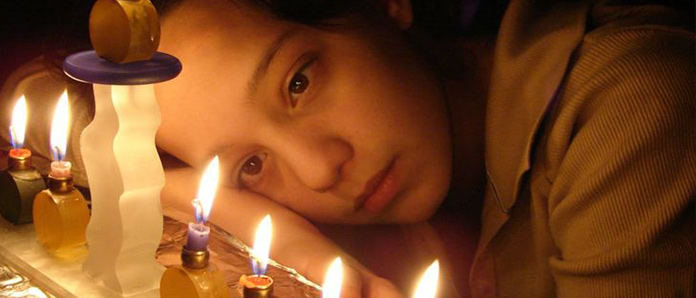
It was Hanukkah, and Herr König was looking for a place where he could fulfill the mitzvah of kindling the Hanukkah lights. After a long search, he managed to spot a window in the distance with candles burning in it. As he came closer, he could even make out the sounds of the hymn “Maoz Tzur”!
“Thank G-d,” thought Herr König. “Here I will find both a place to spend the night and an opportunity to light a Hanukkah menorah!” He knocked gently and explained his situation to the people who lived there... And he was warmly welcomed into a cozy Jewish home.
After Herr König lit the Hanukkah lights, he was invited to share dinner with the family. Soon he felt right at home and even decided to join in the traditional spinning-top game, dreidel.
The guest had a remarkable gift for winning children over; soon he was playing with them as though he had done nothing else all his life. Little Leah especially caught his attention: she stayed cheerful whether she won or lost the game.
Feeling thirsty, Herr König turned to the girl: "My dear, would you bring me a glass of water?"
Silence fell over the room; the girl remained seated, while her brother quickly got up and brought the guest some water. Herr König decided to ask his hosts what this silence meant.
The girl's father answered quietly: "To our great sorrow, our Leah cannot walk. It has been a year since her legs became paralyzed."
Herr König felt terrible—his awkward question had ruined the festive atmosphere in the house! But just then Leah spoke up: "I ask you all not to be sad on my account today. Please don't spoil my wonderful Hanukkah evening!"
The children soon regained their good spirits, but the guest could not simply put the problem out of his mind. He spoke with Leah's parents for a long time, and they told him that they had already tried everything possible, sparing neither time nor money, but the local doctors no longer had any hope that the girl would recover.
Herr König tried to give little Leah's parents renewed hope: he had heard of a similar case in which even renowned professors had "washed their hands" of the matter, yet after a long course of treatment at the famous Charité hospital in Berlin, the patient had recovered completely!
The guest advised Leah's parents to send the girl to Berlin for treatment. He was willing to take Leah there himself and care for her together with his family. He also knew the hospital director personally and would try to secure special consideration for the girl...
Her parents were touched by this offer, but left it to their daughter to decide whether she wanted to go with Herr König. Without much hesitation, the girl agreed.
In Berlin, the König family welcomed Leah as one of their own. A few days later, Herr König took her to the hospital to be examined by the professor. After a thorough examination, he said regretfully: "I cannot promise any positive results. The paralysis is already very advanced. But I will try to do everything in my power—and the rest is in G-d's hands."
The König family arranged for kosher food to be delivered to the girl and visited her every day. The first few weeks passed without the slightest improvement in little Leah's condition...
About two months later, while visiting Leah, Herr König was astonished: the girl stood up on her own! Both he and the professor were speechless with joy at this improvement. Herr König wanted to delight Leah's parents with an urgent telegram, but the professor stopped him: he knew from experience that in such cases there could be a "relapse" to the previous condition, and advised waiting before sharing the happy news.
Meanwhile, Leah's condition continued to improve; on Passover, she was able to celebrate the Seder at the König family's home. Once again, Herr König wanted to send word to her family, but this time Leah herself stopped him: "I want to surprise my parents when, with G-d's help, I have recovered completely!"
A year passed. Hanukkah came again.
"It has been a year since we sent our little Leah to Berlin," Leah's father said to his wife. "Of course, she writes to us fairly often, but her letters contain not a word about the success of the treatment..." His wife replied that she could no longer bear missing her daughter: "After Hanukkah, we must go and bring her back home!"
Once again, the family gathered around the table after lighting the Hanukkah candles, and the children played dreidel. Suddenly, there was a knock at the door, and Herr König appeared on the doorstep. Everyone in the household showered him with questions: how was Leah, and when would she be able to come home?
Herr König pretended not to hear the questions and turned to the children: "My dears, I have brought you a wonderful Hanukkah gift. Since the package is simply enormous, I had to leave it outside the door..." The children rushed outside and came face to face with a girl in festive clothes, standing upright on her own legs without any support. It was their Leah! Leah's parents cried with joy, as did Leah herself and her brothers and sisters. It was the most wonderful Hanukkah gift!