Lea Odelia
"[Both opinions in] every dispute [conducted] for the sake of truth will ultimately prevail, [without negating one another], whereas an argument for argument’s sake is fruitless. An example of a dispute for the sake of truth is the dispute between Hillel and Shammai, and of an argument for argument’s sake—the dispute of Korach and all his associates [with Moshe]" (Tractate Avot 5:17).
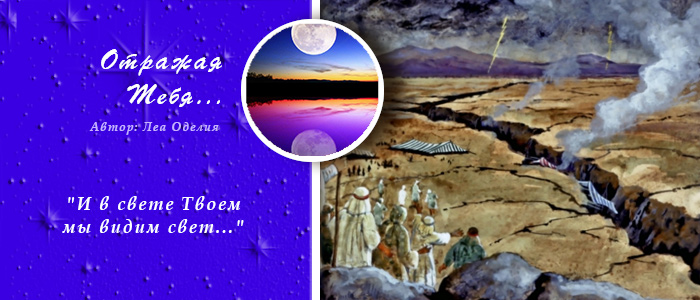
All normal people teach their children that quarreling is very bad! Tut, tut, tut! And inciting discord and rebelling are worse than nuclear war. On the other hand, it is impossible to live without conflict. How else can we build relationships with those around us? There were plenty of squabbles among the people of Israel, too, long before Korach. Yet his punishment was incomparable. A new "natural" phenomenon was created for him: the earth opened up, swallowed Korach’s entire congregation, and closed its mouth… (It had opened before, but this was the first time it closed.) Why this way?
Let’s dig deeper. Or rather, let’s briefly venture into the 6 days of Creation.
The first day is called "yom echad"—day one—unlike the days that follow (second, third, and so on), because the Creator’s unity prevailed and there was no division. Division occurred on the second day: the upper waters were separated from the lower waters. Such is the order of things. So far, everything seems lovely. Yet at the very moment of separation, the lower world gained the potential to consider itself separate from its higher source! It is understood that Gehinnom was created on the second day, and this is the only day of which it is not said, "and the Almighty saw that it was good" (according to Midrash Rabbah). Monday is a tough day, as the saying goes…
Now you have 2 options: either you accept the hierarchy established by the Creator and your place within it, or you declare yourself autonomous, isolated from His influence and that of those around you. In the first case, a person becomes an integral link in creation, a rung on a ladder that someone can climb upward, and through which the Creator’s influence descends into the lower world (remember Yaakov’s ladder—this is a constant process of descent and ascent. Incidentally, this is why the patriarch is not mentioned in Korach’s genealogy: "Korach, son of Yitzhar, grandson of Kehat, and great-grandson of Levi." His behavior violated the fundamental principle of the interdependence of the 12 tribes). Pull out one rung, and that’s it! The order of the universe is disrupted. And this is Korach’s rebellion. He tried to disrupt the hierarchy, which is tantamount to blocking the channel through which the upper world influences the lower world. That is why the punishment was symbolic: you wanted a disruption in the order established by the Creator? You got it! You don’t need a blue thread in your tzitzit, you don’t need people who stand out from the crowd, you don’t want to feel beneath anyone? You will be beneath the earth itself. (Have you noticed that people who consider themselves above others and people who consider themselves below others suffer from the same feeling of inferiority? That is where it comes from.
Because it is inscribed in everyone’s spiritual root that we are all equal, and that each of us has a unique purpose in the world. Only discontent and the desire to take someone else’s place make a person feel inferior.)
And this is the essence of discord. That is why the Torah devotes so much attention to relationships between people, why we all cry out about the need for unity and the unacceptability of strife. This is not simply a matter of "what is good and what is bad"; there is an absolutely clear connection between cause and effect!
P. S.: Notice that not every conflict leads to destruction. In many cases, quite the opposite. A dispute in a shared search for truth, spouses working through their differences to understand each other better, a conversation with a child for educational purposes—all of this is beneficial :)
It all comes down to one small question: "Am I building or destroying?"...
Something like that…
Don’t be like Korach! Be like Moshe and Aaron!
May we have peace! Chodesh tov!