Rebbetzin Chava Kuperman
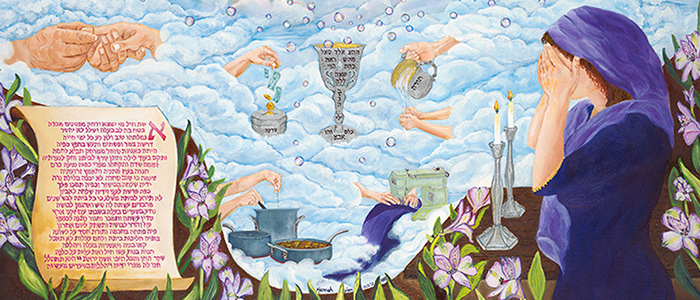
ESHET CHAYIL (Mishlei, 31:10-31)
The song “Eshet Chayil” (“A Worthy Wife”) concludes King Solomon's book “Mishlei.” It is written as an acrostic in which each successive line begins with the next letter of the alphabet, spanning the whole alphabet from the first letter to the last.
But why did King Solomon include this song specifically in “Mishlei,” his Book of Proverbs?
In one of the earlier sections devoted to Bathsheba, King David's wife and Solomon's mother, we already gave this work some attention. Now it is worth examining it in more detail. (May the reader forgive any repetition).
So, “Eshet Chayil” was composed and sung by King Solomon in honor of his mother Bathsheba after she had sternly reprimanded him.
This is how it happened.
When David died, twelve-year-old Solomon ascended the throne and became king. From that moment on, no one in the kingdom can say a single unpleasant word to him—he is the King! The only person who continues to raise him is his mother. One morning Solomon is late for the start of the Temple service (the priests did not begin offering sacrifices until Solomon arrived). That day, the king had a valid reason: the day before, he had married Pharaoh's daughter, and after the wedding came the wedding night! But Bathsheba believed that none of this excused being late for the service, and Solomon records in “Mishlei” “the words with which his mother admonished him.”
We will not quote them in full, but will focus on just one phrase: “What, my son? What, son of my womb? What, son of my vows?!”.
None of David's wives, when asking the Almighty to send her a child, asked for a righteous son. Only Bathsheba did. The other wives wanted healthy, handsome, strong children who would become David's heirs—wealthy, strong, and powerful. They made vows to that end. But for Bathsheba, what mattered most was that her future child be righteous.
“What will become of my vows if you act unrighteously?” she asks her son. And Solomon understands: his mother is right; he must heed her voice and thank her for her guidance.
“Eshet Chayil” is that expression of gratitude.
It is believed that praise for a woman can be expressed in one of twenty-two forms. “Eshet Chayil” has twenty-two lines (as many as there are letters in the alphabet). This means Solomon uses all twenty-two forms of praise here. The maximum! There can be nothing higher!
That is on the simplest level. We can look deeper.
We will do that next time...