Rebbetzin Chava Kuperman
The next verse of Eshet Chayil:
"She is girded with strength; her arms are strong..."
According to tradition, this refers to Miriam. Why? In Judaism, girding oneself signifies strength, power, and heroism; someone who must rise to a difficult occasion needs to gird herself.
Miriam had to do this at least twice: first, when she defied Pharaoh's will after he ordered Jewish babies to be killed during childbirth, and second, when she asked her father to reconsider his decision to divorce her mother. It is very difficult for a child to intervene in her parents' relationship. But Miriam intervened: "What you are doing is an even greater evil than what Pharaoh is doing, because his decree is directed only against boys, while you are preventing both boys and girls from being born." She also told her father that he must remember: all his decisions are the decisions of a righteous man, which means they will be followed, whereas the decisions and decrees of the wicked Pharaoh will by no means be followed by everyone. And she also said: "I see that a child will be born to you who will one day free the Jewish people from slavery." Her father listened to his daughter and reunited with his wife.
But then the child was born, and everyone first rejoiced, then grew sad and asked: "Miriam, what will become of your prophecy?"
She was concerned about this too. After three months, the baby could no longer be hidden, and he was taken to the bank of the Nile. The Torah says: "His sister watched from a distance, from the thickets on the bank." Why was it Miriam who watched, rather than someone else? Because she was the one who went to "stand watch over her prophecy"—to safeguard the prophecy, feeling responsible for it.
The oral tradition says that every verse of Eshet Chayil also refers to Sarah. After completing our main analysis, we will examine this connection too. For now, we will simply note that when the angels came to Abraham, he asked his wife to bake bread for them. When making the challahs, Sarah took one se'ah of flour for each guest, three se'ahs in all. That is about 24 kg!
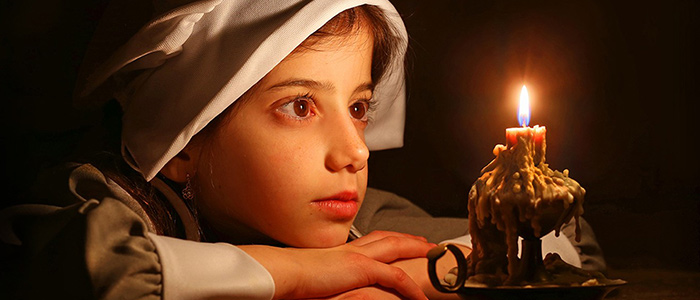
"Seeing that her work is good, she does not put out her lamp all night…"
This refers to a particular night.
According to one opinion, this refers to Batya, Pharaoh's daughter, and the night when all the firstborn of Egypt, male and female, were killed. Batya was also a firstborn child, and she was to die that night. In his book Proverbs, Solomon says that the "candle of the Almighty" is a person's soul. The candle's not going out thus means that Batya would remain alive that night.
What does "she saw that her work was good" mean? She saw that what she had done was especially good; she witnessed this with her own eyes.
Let us explain in more detail.
It says that when Moses was born, Yocheved saw that he was good and hid him for three months. (Of course, all mothers think their children are the best, but what Yocheved saw was especially good: the child was born circumcised. Because of this, he received one of his names—Tuvia—"Good from G-d.") And Batya, unwrapping the rescued child's clothes, saw the same thing and understood that she had saved no ordinary baby, but a special one, and therefore her soul would not be extinguished.
There is also an opinion that the quoted verse refers to Hannah.
"She tasted and saw that it was good" refers to prayer. Hannah gave us the rules and themes of prayer. Her son Samuel, whose birth she prayed to the Almighty for, is the only person compared to Moses and Aaron (Psalm 99, which we recite when welcoming Shabbat, says: Moses and Aaron are among His servants, and Samuel is among those who call upon His Name (pray to Him)).
That is why Samuel, Hannah's son, is also tov —good, like Moses.
The phrase "Her candle will not go out at night" echoes what is said in the book of 1 Samuel (chapter 3, verse 3): "And the lamp of G-d had not yet gone out, and Samuel was lying in the Temple of the L-rd, where the Ark of G-d was." (This refers to the Mishkan at Shiloh, where the prophet Samuel receives his prophecy.)
to be continued