Rebbetzin Chava Kuperman
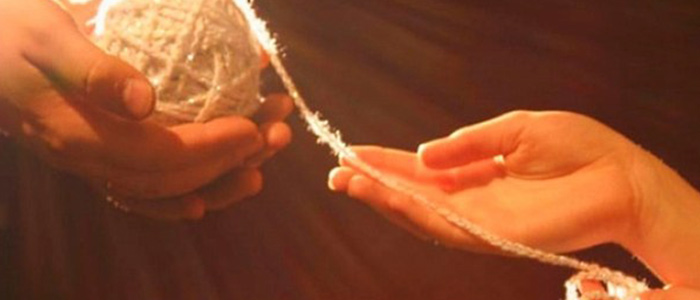
“She acquires wool and flax and willingly works with her hands”…
There are quite a few tasks that a woman is not obliged to perform herself. She need only give instructions, and others will carry them out. The exception is sewing clothes, especially when working with expensive materials (wool and linen have always been highly valued). Such work requires special skill and is done by the woman herself, “with willing hands.”
Eve, by prompting Adam's first sin, brought about the need for people to wear clothing. And now she is rectifying that sin. This is why, in Judaism, pelekh —the spindle—is considered a woman's occupation.
According to Midrash HaGadol, the verse quoted above is devoted to Leah. Her descendants were the Levites, from whom came the kohanim, the priests. Aaron the Levite became the first High Priest. His garments for the Temple service had to contain a mixture of linen and wool (known as shaatnez, which is forbidden to an ordinary Jew). This mixture in the garments used for the service was intended to atone for the world's first murder, committed over an offering. (Cain killed his younger brother Abel because the Almighty responded to Abel's offering and accepted it, but did not accept Cain's.)
The root of the sin is the older brother's envy of the younger.
As the Torah states, Cain brought his offering from the produce of the earth. We have a tradition that it was flax (as Rashi and the commentaries on Rashi explain).
(If we use the system of milui (“addition”) and examine the names of the letters that make up the word korban, an offering, we find that the last two letters form the word pishtan (flax). The fact that pishtan comes at the end of the word korban, indicates that it is, as it were, a remainder. Indeed, Cain brought what was left over rather than something choice, something “honorable.”)
And from that moment on, firstborn sons began to have problems. The Almighty arranges things so that the firstborn always falls short of the second son in his qualities. This is necessary so that the firstborn will improve himself—rooting out his envy. (Unfortunately, such work is difficult and does not always succeed.)
The examples are well known. Ishmael and Isaac, then Esau and Jacob, then Jacob's sons and Joseph.
The same is true of Joseph's sons—Ephraim and Manasseh. (Remember how Jacob, when blessing them, switches their places and makes the first become the second.)
According to one view, when we bless our children at the start of Shabbat, we mention Ephraim and Manasseh precisely because theirs was the first case in which the older brother did not envy the younger.
The second such example is Aaron and Moses. Remember, the Almighty sends Moses to Egypt to lead the Jewish people out of slavery. Moses does not want to go because he believes he has no right to do so: he has an older brother, Aaron—this is the firstborn's mission. The Almighty reassures Moses: “Aaron will be happy for you and will support you in everything!”
To Aaron, G-d says: “You have now rectified Cain's sin. Therefore, you and your descendants may wear linen and wool together.”
But there is another view, according to which this verse refers to Sarah.
What does “flax and wool” mean?
Isaac's symbol is the lamb offered as a sacrifice in Isaac's place. Wool is what is taken from a sheep. Flax symbolizes Ishmael because Ishmael's mother, Hagar, was Egyptian. Egypt was famous for its flax and was called the land of flax; people there knew how to make exceptionally fine linen. (Egyptian mummies were wrapped in linen.)
For this very reason, sheep's wool may not be mixed with linen thread. Sarah said: “Mixing linen and wool is forbidden; Isaac and Ishmael cannot live in the same house.”
“She is like merchant ships; she brings her bread from afar”...
Indeed, a merchant ship must make a long and difficult journey to deliver the needed goods to the harbor.
Likewise, Rachel, to whom this verse relates, had to travel a long road in prayer before G-d granted her plea for a son. Like a ship alone on its voyage, she too was alone. No one helped her, not even her beloved husband. When she asked him to pray that G-d would give her a son, he replied: “Am I in the Almighty's place?” The Midrash says that concerning Joseph's birth, it is written: “And the Almighty remembered Rachel.” (Rachel, not Jacob!)
to be continued