Basya Tsybukmakher
Preparation
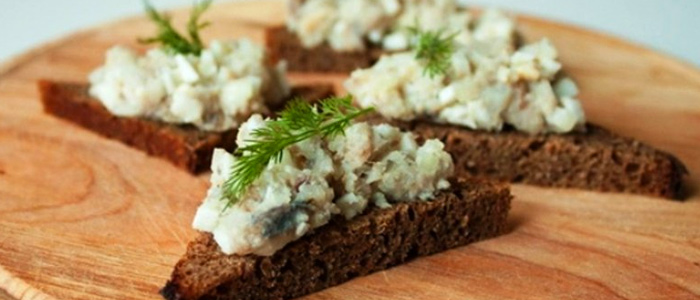
Forshmak! To the uninitiated—a grayish, rather unappetizing mixture that smells of fish. To the well-read—the food of poor Ashkenazi Jews, devised on the principle of “how to feed a large family with a single herring tail.” To polyglots—a Yiddish name derived from the German “Vorschmack,” an appetizer.
But you and I know that good forshmak is the pride of any table, a gourmet's delight, a taste of holidays and childhood. And that there are as many recipes for it as there are Ashkenazi families.
...In our home, Dad always cleaned the herring. And it was a sacred ritual that required thoughtful preparation. If only because a person up to his elbows in herring is unavailable for any other earthly activity. He cannot even scratch his own nose, let alone go to the telephone. So: roll up your sleeves, put on an apron, get the sharp stainless steel knife ready—the very one with its handle wrapped in blue electrical tape; spread newspaper on the table (no, printer's ink is not an essential ingredient in forshmak). Announce loudly, for the whole apartment to hear: All right, I'm cleaning the herring!
The family flocked to that call. Since there were so few of us, it was usually I who flocked. I would lie on my stomach on a free patch of table (“Don't get yourself filthy! You'll be impossible to get clean afterward!”) and wait, like a dockside cat, for my reward: herring backbones, which were so delicious to suck on, gnaw at, and chew.
Only while cutting it up did we discover what kind of herring we had actually bought. Fatty? Spiced? Was it “rusty”? Too salty? Might there be delicious roe hidden in its belly rather than pointless milt? Should we cut it into pieces, put it in a jar with some onion, cover it with sunflower oil, and serve it with potatoes? Or make forshmak after all?
Lightly soak the white bread in water—not as thoroughly as you would for cutlets, but so that it stays somewhat dry. And squeeze it out thoroughly. Finely chop the onion. If you want to remove its bitterness, put the chopped onion in a sieve, quickly scald it with boiling water, and immediately rinse it with very cold water. Pat dry. Mince the herring: by hand, in a meat grinder, or in a blender—whichever method you can be bothered with. Crumble the bread. Finely chop the hard-boiled eggs. Combine the ingredients and season with sunflower oil (and no other vegetable oil). You can also add a small piece of softened butter.
At this point, in theory, it is time for the grated apple. The problem is that, in fact, only one variety works here: Antonovka. And it can be found in just one geographical location, and even there only in season. Replacing Antonovka in forshmak with the first apple you happen to find is pointless. So I have taken to seasoning forshmak with a spoonful or two of really good apple cider vinegar. Beggars can't be choosers, as they say... And it keeps longer, too.
You won't have to keep it for long, though. Put the forshmak in the refrigerator, and the next time you look in there—I assure you—there will be no more than half left. The main thing is to have bread and good butter in the house.
Kitchen measures
| Ingredient | Cup | Tbsp | Tsp |
|---|---|---|---|
| Wheat flour | 140 g | 10 g | 3 g |
| Sugar | 200 g | 12 g | 4 g |
| Salt | 290 g | 18 g | 6 g |
| Butter | 230 g | 15 g | — |
| Powdered sugar | 120 g | 10 g | 3 g |
| Honey | 320 g | 22 g | — |
| Cornstarch | 140 g | 10 g | — |
| Cocoa | 140 g | — | — |
| Oil | 200 g | — | — |