Zissi Skarzhinskaya
Our Sages said (Berakhot, 10a): “Even if a sharp sword rests upon a person’s neck, let him not despair of mercy (from the L-rd).”
“With this the Torah cautions us: if a person sees that trouble is near, let the L-rd’s salvation be in his heart, and let him rely on that salvation, as it is said (Psalms, 85:10): ‘His salvation is near to those who fear Him,’ and it is said (Isaiah, 51:12): ‘Who are you, that you should fear a mortal man?!’”
Thirty whole gold rubles! A whole thirty! In gold!
When you are twelve years old and have thirty whole gold rubles, you are… Well, practically a bridegroom. And a respectable man in every way. At any rate, not every adolescent has such impressive funds at his disposal.
Yosef felt that, were it not for his venerable age, he would have hopped on one foot, as though he were still plain Yoske. Instead, he merely drew the delicious frosty air in through his teeth. Ahhh… Hanukkah was wonderful in Makhnovka. There had just been a little frost, and the snow sparkled and crunched underfoot. He had finished making the rounds of his relatives with the latkes his mother had fried, and everyone had given him Hanukkah gelt. He put the money in a little bag on a string and hung it around his neck. Together with what he had saved in previous years, it came to an impressive sum. Yosef did not spend his savings; he was generally good with money and very focused on his goals. Although he was still only studying in cheder, certain things had firmly lodged in his memory. For example: “Who is mighty? He who conquers his evil inclination.” And so, instead of running off to buy sweets like the other boys, he saved his money. Or another saying: “If I am not for myself, who will be for me? And if I am only for myself, what am I? And if not now, when?” Exactly—when he had enough money, he would start his own little business. He tried to live in accordance with Ethics of the Fathers and what he had learned in cheder so far. Besides, his bar mitzvah was coming soon, and he would have to take upon himself the obligation to observe the mitzvot. His father would buy him tefillin, and he would go up to the bimah and read his Torah portion…
A sudden commotion caught his attention. A few minutes later, the shouts came closer:
“Makhno! Batko Makhno is coming!”
Yosef ran home.
“Dad, what’s happening?”
“They say Makhno is coming. He has ravaged the neighboring village and burned the houses. Now they’re heading here. We have a couple of hours. We’ll load everything onto the cart and head for the forest. Let them burn the house—we’ll still be alive. If they don’t stay long, we’ll come back. It is winter, after all.”
Yosef and his two sisters hurried to help their parents get ready. In those troubled times, many armed bands roamed Ukraine, though people said that Batko Makhno did not approve of pogroms and that discipline in his troops was no empty phrase. But who could know? Jews were a cautious people, taught by bitter experience. Besides, his father believed that none of the rapidly changing authorities was any good for them: “With the Whites, it’s bitter radish; with the Reds, it’s no honey either.”
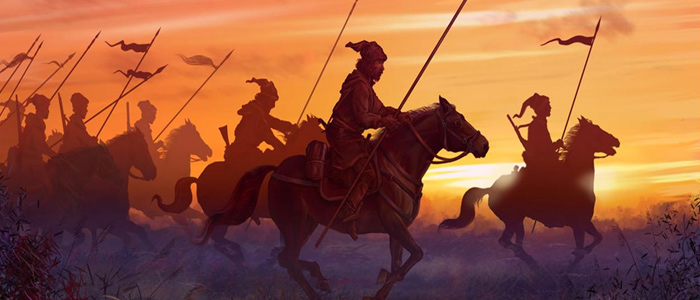
A couple of hours later, the village was half deserted—half of Makhnovka’s population was Jewish. The first to burst into the village were some thirty bandits on horseback, shouting loudly and brandishing their riding whips. They scattered the remaining passersby, and everyone hid in their homes. Then a slow-moving column of horsemen appeared at the end of the main street. Two rode in front, calling out in ragged unison:
“Batko Makhno has forbidden the burning and plundering of the village of Makhnovka, on account of the similarity between its name and his surname! We ask the population to share their surplus food for the needs of the First Revolutionary Army. Horses and carts will also be nationalized. Workers of various trades, especially blacksmiths, are to assemble at the army’s temporary headquarters. Everyone report for voluntary mobilization!”
An hour after entering the village, Makhno’s men hung a black flag on one of the houses on the main street, bearing the words “With the oppressed against the oppressors, always!” They also put up a handwritten poster with appeals, some of which had already been announced. Not a single house in the village was set on fire. Seeing no smoke, the Jews hiding in the forest could only guess at the plans of Makhno’s men. Yosef decided to go and scout things out. Naturally, without asking his father. It was obvious that he would never have been allowed to go. Feeling his little bag of treasure through his fur coat and vest gave Yosef courage. He slipped unnoticed out from behind the carts and headed toward the village. It gets dark early in winter. In the darkness, his little black fur coat did not stand out against the tree trunks.
The village seemed quiet. The dogs, finishing their evening chorus, were falling silent. Warm light glowed in the houses. No, not in all the houses—as far as Yosef could tell from the edge of the forest, the Jewish homes were still dark. He stood beneath a tree and watched. There seemed to be no sign whatsoever of Makhno’s men.
Suddenly, something hard jabbed him beneath his shoulder blade.
“Hands up, boy.”
Turning around, Yosef saw an unfamiliar man in a short sheepskin coat, with a black bow and a rifle.
“One of Makhno’s men!” Yosef thought, rather incongruously. “So that’s what they look like!”
“What are you peering at, eh?”
“Nothing, Mr. Officer!”
“You’re lying! You’ve been hanging around here for a quarter of an hour! About-face! Forward—march!”
Prodded by the rifle barrel, Yosef walked deeper into the forest for several minutes. His attempts to turn around and speak earned him a light blow to the head with the rifle butt. Yosef stumbled, then continued on in silence. His thoughts were jumbled, but he was not yet allowing himself to panic.
“Stop right here!”
“Mr. Officer! I really wasn’t spying! My home is over there. I’m from Makhnovka! A local.”
“Enough talk! I’ll finish you off first, then work out what’s what!”
The man calmly took aim. Yosef closed his eyes and began silently reciting “Shema Yisrael…” In his mind, he had already said goodbye to his father and mother, asked their forgiveness for slipping away without permission, and kissed them. Tears welled up in his eyes. Would he really never see them again?! Yosef began to sob aloud, realizing that his life would end here.
There was no shot, only a dry click. And silence. Surprised, Yosef opened his eyes. The man stood opposite him, examining his weapon.
“Strange,” he said. “It’s never misfired before.”
Yosef realized that this was his chance.
“Mr. Officer, I really am from Makhnovka. We left because we thought Makhno carried out pogroms, like the others. But that isn’t so. I saw our house—it’s intact. Sir, surely you aren’t allowed to kill people just like that. You ought to take me to your commander and sort things out. Even the dogs in the village know me.”
No answer.
“Sir, I have money. I can buy my freedom!”
The man raised his head.
“How much?”
“Thirty rubles in gold.”
“Mmm… All right, hand it over. They don’t shoot you twice, anyway. And not a peep out of you—say one word, and I’ll hunt you down wherever you hide.”
Yosef quickly unbuttoned his fur coat and vest, pulled the string with the little bag over his head, and emptied his savings into the dark, calloused hand. The man tied the money into his sash and walked toward the village without looking back. Yosef stood there for a little while, recovering his senses. Only now did the full horror of what he had experienced catch up with him, engulfing and paralyzing him, but the December frost brought the young boy out of his stupor. He became hysterical with relief. Laughing and crying, he ran back to his family to tell them what had happened. As he ran, he thanked the Almighty for his miraculous rescue, for the gift of life.