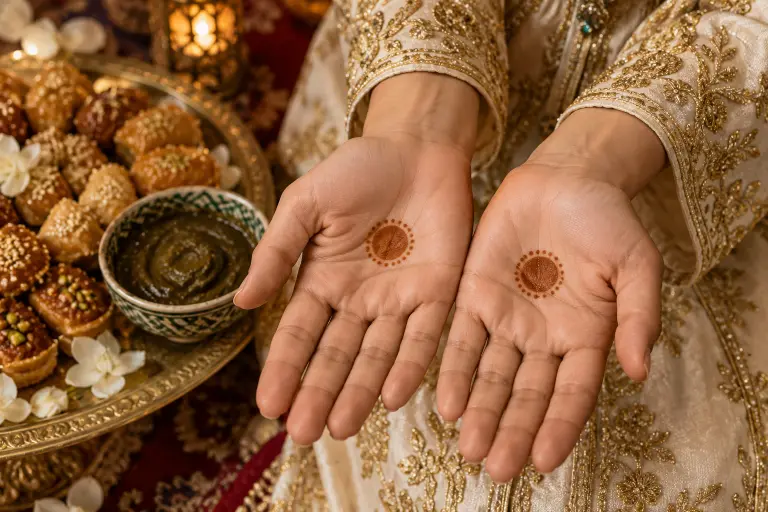
The famous henna night (in Hebrew, “Hina”) is an incredibly vibrant, authentic, and noisy pre-wedding ritual. It is widespread among Sephardi (Eastern) Jews originating from Morocco, Tunisia, Yemen, and India, as well as among Mountain Jews and Bukharan Jews.
In modern Israel, the Moroccan Hina has become an enormous celebration in its own right, sometimes rivaling the wedding itself in scale.
Traditionally, the bride’s family is responsible for organizing the Hina and providing the refreshments. The celebration takes place in an atmosphere of unbridled Eastern revelry and consists of several key stages:
Traditional Dress and Outfit Changes
For the Hina, the guests—and above all, the bride and groom—change into luxurious traditional costumes.In the Moroccan tradition, these are gold-embroidered robes (takchitas and kaftans), and the bride wears a large, sparkling traditional headdress. Over the course of the evening, the guest of honor may change into at least 3–4 dresses in different colors. Relatives and friends also often dress in traditional clothing, creating an incredibly colorful atmosphere.
A Parade of Gifts and Sweets
To the sound of deafening Eastern music and rhythmic drumming, enormous, lavishly decorated trays are carried into the hall. They are piled high with traditional sweets: baklava, marzipan, pastries with honey and nuts, and dried fruit. The sweetness symbolizes a sweet, happy life for the future family. The trays also hold expensive gifts: by custom, the groom’s mother gives the bride gold jewelry (bracelets and rings), while the bride’s mother gives gifts to the groom (a watch, for example).
All these gifts are prominently displayed as they are carried before the guests, with people dancing while holding the trays.
The Henna Application Ritual
At the climax of the celebration, the bride and groom sit in special “royal” chairs. The older women in the family (usually grandmothers or mothers who are happily married) mix a paste of natural henna.A woman takes a little henna and applies it to the bride’s and groom’s palms in the shape of a round coin. To avoid staining their clothing, their palms are wrapped in beautiful silk ribbons or covered with special embroidered gloves. This paste is also applied for good luck to the palms of any guests who wish to receive it. The henna leaves an orange mark on the skin that lasts for several days.
The Hidden Spiritual Meaning:
Beyond expressing a wish for wealth and well-being (through the coin shape), the word “Hina” (in Hebrew, חנה) is interpreted in Jewish tradition as an acronym for the three principal commandments (mitzvot) entrusted to a married Jewish woman:1. חלה (Challah)—separating a portion of dough when baking bread.
2. נידה (Niddah)—observing the laws of family purity.3. הדלקת נרות (Hadlakat Nerot)—lighting Shabbat candles.
In this way, the ritual becomes a joyful yet spiritually profound initiation of a young woman into her role as a Jewish wife.
Henna night among Yemenite Jews differs considerably from the Moroccan celebration in its costumes and songs.