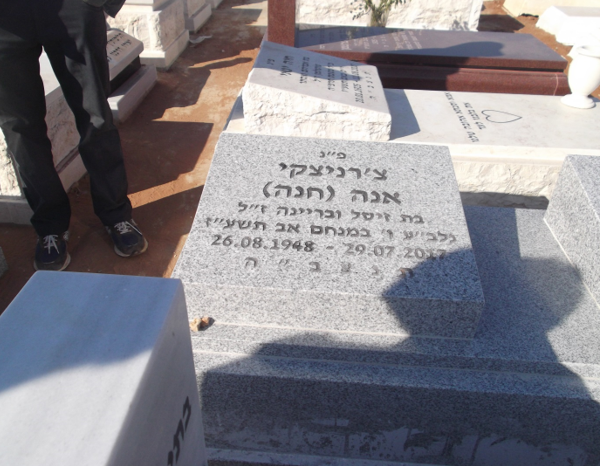
Zissi Skarzhinskaya
In this week's Torah portion, we read about the burial of the first mother of the Jewish people—Sarah Imeinu.
“And Sarah's life was a hundred years and twenty years and seven years—the years of Sarah's life. And Sarah died in Kiriath-arba, which is Hebron, in the land of Canaan. And Abraham came to mourn for Sarah and to weep for her. And Abraham rose from before his dead, and spoke to the sons of Heth, saying: I am a stranger and a resident among you; give me a burial possession among you, so that I may bury my dead out of my sight.”
Everyone fears losing their mom. And when it happens, you stand there bewildered, because this is an entirely different reality. Before, you were “a person with a mom.” Now you are “a person without a mom.”
And at first, of course, there are all the arrangements for the final chesed you can still do for someone dear to you. Then comes the funeral; there are people all around you, some of them strangers, and it is very hard to show your grief, so intimate, so personal, in front of everyone.
And then comes shiva, when you need to remember and share something essential about your mom, something important to leave as a lasting memory of her—so special, so devoted, warm, dependable. Such a solid wall behind you. “The sun gives warmth; a mother gives kindness.” And you want to recall something that will help people understand what this person meant to you. But it is hopeless!
Everyone has their own mom, and it is impossible to explain why your mom in particular was special.
In this week's Torah portion, we see not only Abraham's relationship with his wife but also Rebecca's relationship with her mother. “And the maiden ran and told her mother's household about these things.” Rashi says: “A woman generally had her own house, where she did her own (women's) work. And a daughter tells things (confides her secrets) only to her mother.”
Mom was always my best friend (no offense to my friends). I could tell her everything that was happening to me, all my news, without worrying that she would judge me too harshly. Of course, she did not like everything, but after a while she would accept my choice and let me move forward, supporting all my endeavors. She was the best mother a teenager could have. I did not have a difficult adolescence, because Mom knew how to be accepting. She knew how to meet me as an equal, to understand me as a peer would, while still remaining a parent, without becoming overly familiar.
It has been more than three months since she passed away. And today is my first birthday without Mom, without whom my life would not have begun on this day. Without her, this celebration has no meaning. After all, it is her celebration more than mine…
My dears! All of you whose mothers are still alive! Cherish them!
The most frightening thing is to turn around and find—emptiness. And although I still often talk to Mom, I no longer hear her answer. All I can do now is hope that techiyat hameitim comes soon!