Rabbi Yonatan Eybeschutz
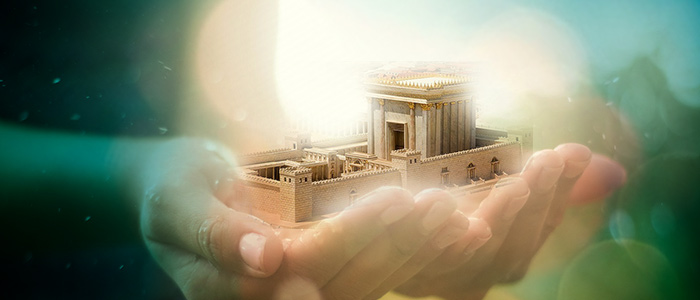
The blessings “And to Jerusalem, Your city” and “The sprout of David, Your servant”
There is no need to speak at length about these blessings—about the need to shed an uninterrupted stream of tears, asking for Jerusalem (the Temple) to be rebuilt and for David’s power and glory to be restored, since he is the goal and symbol of human perfection, and if we have neither Jerusalem nor the kingdom of the House of David, what do we have to live for? For Jerusalem, we ask that the throne of the Almighty’s glory be restored, and we also pray for David, who sat there (on the throne of his kingdom) as a literal likeness of the “supernal chariot.” And if the angels above cry out in weeping and mournful song over the destruction of Jerusalem day and night, without ceasing, and they mourn Zion, how can we remain silent and fail to mourn the desecration of the Almighty’s Name caused by the destruction of Jerusalem and the loss of the kingdom of the House of David? Every person should say in his heart: “Master of the world! Behold, I surrender my soul for the sanctification of Your Name! And if I am not worthy to see Zion rebuilt and the restoration of the kingdom of the House of David, let me die for the sanctification of Your Name, and let my eyes not see it—but You rebuild Jerusalem and cause David’s power and glory to flourish, so that Your Name may be sanctified! And have compassion on Your unfortunate sons, abandoned in exile, suffering for the sake of Your unity and sanctifying Your Name before many!” And everyone knows that because of our many sins, our glorious Temple has been destroyed and lies desolate, the kingdom of the House of David has been lost, and how much goodness we lose because of this; we have literally descended from life into death! And conversely, it is known that when the Almighty returns the captives of Zion, the world will be transformed from dead to living—and so there is no need to say much about all this. And who, if there is a Jewish soul within him, would not have his heart broken by the memory of the destruction of Jerusalem and of the kingdom of the House of David, which came to an end because of our many sins!
The blessing שמע קולנו – “Hear our voice”
Here a person should concentrate fully on praying to the Almighty for all his needs, great and small, and there is nothing about which one should not turn to the Almighty. The general rule is this: there should be no undertaking that we wish to carry out that day about which we do not pray, asking that it be accomplished successfully, in an upright and proper way. And it goes without saying that if a person has some misfortune in his home, G-d forbid, he must pray. And if there is some joyous occasion, he must pray not to sin by giving himself over to that joy and thereby incur guilt—to pray that this event should not, G-d forbid, be a joy followed by sorrow. Therefore, let a person pray about this matter in his own words; even if his language is poor and awkward, his prayer will be beloved by the Almighty as though he had prayed beautifully and eloquently. Through his prayer, the Almighty will also hear our prayers, and it will benefit us, because his prayer will undoubtedly be uttered with concentration and the proper mindset, and his lips and tongue will not be in one place while his heart is in another, as is the case with people who pray by habit and rote. For each day he prays about something new that he needs that day, and he composes the words of his prayer himself, which undoubtedly requires special concentration. This is the foundation of prayer: that it should come from the depths of the heart. Another great benefit of this prayer is that through it he affirms in his heart the truth that a member of the people of Israel is not left to the power of chance and the natural course of time, as though he had no need for prayer. On the contrary, diligence, effort, and hard work (in material matters) are a falsehood, not the foundation of success, for it is the Almighty alone who determines what happens to a Jew at every step, and he will not move a finger in the lower world until it has been proclaimed in the higher worlds. Through this prayer, he will take to heart how carefully he must guard against transgressing the command uttered by the King who reigns over the kings of kings, the King of the universe, for everything comes from Him, under His personal supervision, and everything that happens to a person, every loss and every misfortune, all comes from Him; and likewise, every gain, blessing, and pleasure also comes from Him! He will not think of sinning with the very thing that he asked the Almighty for—and received; for how could he ask for wealth only to use it afterward to anger his Creator? Thus, someone who constantly prays for all his needs will not sin so easily.
The blessing רצה... בעמך – “Be favorable… toward Your people”
Here a person surrenders his soul to the service of the Almighty. He should imagine himself already bound upon the altar and desire very, very strongly to die upon it for the sanctification of the Almighty’s Name—to become a burnt offering. And since this desire has arisen in him, there must be no blemish in him. But if he has sinned with one of his bodily organs, that is a blemish; that organ will not be acceptable, and before the offering he must return to the Almighty. Therefore, the entire sequence of blessings, everything for which a person has prayed up to this point, is dictated by the need to set himself right by returning to the Almighty, so that no blemish will be found in that offering. And now, when a person surrenders his soul for the sanctification of the Almighty’s Name, no blemish remains upon him, since he has washed away his sins. He should pray fervently that the Almighty restore the service to its proper place, for there the rectification of the whole world takes place; and our heart grieves over this—over “Mount Zion lying desolate, foxes roaming over it” (Lamentations, 5:18) and the cessation of the service. A person should pray with a broken heart that the Almighty restore the service to Jerusalem, the city of complete perfection.
And when saying the words: ותחזינה עינינו – “And may our eyes behold” – he should have in mind that he will be granted this through his own merits, because he will be able to see what happens through his own merits, but not what happens through the merits of the Patriarchs, just as Lot’s wife could not witness the destruction of Sodom because she was saved through Abraham’s merit. And the Almighty has promised that Israel will be saved in the future through its own merit, and therefore we say in prayer: “And may our eyes behold.”
Translation by Rabbi P. Perlov.