Zissi Skarzhinskaya
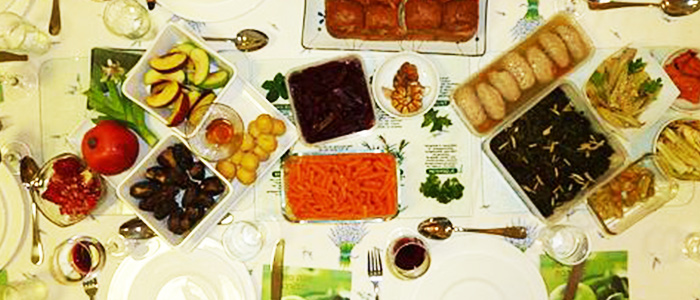
As we all know, on any question, there are as many opinions as there are Jews. This is even truer of Jewish homemakers, each of whom has her own ways, developed over the years, of "surviving the busy season," that is, preparing for the holidays.
Some women can plan their day literally down to the quarter hour, while others have circumstances (read: small children) that give them practically no chance to relax around the clock. Both, however, must eventually face the inevitable: how to prepare for the holiday while losing as few nerve cells as possible. And while everyone manages the little weekly scramble (Shabbat), the holidays call for more careful planning, especially Rosh Hashanah, which is celebrated for two days both in Israel and in the Diaspora. This year, the holiday begins on Sunday, immediately after Shabbat, which does nothing to make the task easier.
Much depends here on how many hours this woman has in her day. Of course, we all have 24 hours, or 1440 minutes, or 86400 seconds. But each woman's productive time for household tasks is different. Some women work 8 hours a day, plus the commute—a total of 10 hours away from home. Others are full-time mothers of large families, whose lives seem to revolve entirely around the home, yet all those "seven little ones lined up on the benches" need attention and patient care. And there are many, many other situations in between and beyond these two examples.
Being organized for the holidays is more than a pleasant dream that makes life easier.
It is the key to peace of mind for the whole family—starting, of course, with Mom and ending with the youngest child. When Mom knows that the refrigerator is full of food, an overturned plate will not provoke too strong a reaction. When all the shirts have been washed (ironed—that is for the perfectionists J), ice cream stains are also taken fairly calmly.
Of course, some women say of themselves, "I work best under stress," or "I start cooking for Shabbat at two in the afternoon on Friday—and everything is fine." But let us admit that they are a very small minority. For us "ordinary homemakers," stress means tension, shouting, tears… It means wanting to crawl into a den like a bear, instead of beginning the holiday meal, and wanting it to be QUIET!
After all, what matters most is that everyone feels good and is in a joyful, festive mood.
And Mom's smile on the holiday is worth more than the most delicious cakes. That is why planning everything ahead of time is so important. But even if you have not, the main thing is to assess the situation realistically, understand what you will have time to do and what you will not (or will, but at what cost…), and stop in time. Perhaps even go and rest.
We wondered how women of different ages, family situations, occupations, and, of course, personalities handle the task of preparing for the holidays. We were interested in several points: holiday shopping in terms of time and expense, preparing the essentials, and time frames.
So, holiday preparations through the eyes of Jewish homemakers:
Our respondents, to whom we are very grateful, shared the methods they have developed, tips, and valuable advice. For greater clarity, we will also give each woman's occupation.
Rivka T., Jerusalem. Ganenet omanut (arts director and kindergarten teacher) and lecturer at a women's institute.
My workweek has no fixed hours at all. I work every day, a full workday—from morning until 5 in the evening, and the round-trip commute takes 1,5 – 2 hours. In the evenings, I teach young women Jewish studies, and I also travel to help my eldest daughter with her long-awaited baby daughter. So there is no such thing as "everything on the last day" for me—I simply cannot afford that. Therefore, my holiday preparation plan has to be put into action ahead of time.
I plan to do most of the shopping a week before the holiday; at most, if guests come, I may need to pick up a few small extras along the way. We also have an additional freezer that can be stocked ahead of time with meat and fish, falafel, bourekas, and other baked goods. That way, if need be, I can take something out and heat it up without running around the neighborhood minimarkets.
The next stage is the Shabbat of the week in which Rosh Hashanah falls. I prepare double quantities of all the hot dishes—meat, fish, filling for blintzes, or even the blintzes themselves. I serve half and freeze the other half for the following Shabbat—all that remains is to heat it up, and that is it!
During the week before the New Year, I work every day—from Sunday through Tuesday—and I have only the evenings left, when I come home tired, wanting nothing but to eat and lie down to rest. As if anyone would let me! But I have firmly decided that every evening I will prepare one dish for the upcoming holidays, for example, one of the "simanim." Salads can be chopped just before serving, as long as all the ingredients are prepared ahead of time.
Liat D., Mexico–Jerusalem. Retired social worker.
I am still looking for work and am mostly at home with the children. But no one has spare time anyway. I feel that I have absolutely no need for last-minute rushes; I get flustered and cannot concentrate when I feel that time is running out.
So I make a plan ahead of time. I will try to get the shopping done a full week before Rosh Hashanah. I make a complete list, including sweets. That means that a week before the holiday, everything I need is already in my refrigerator.
My friend and I also usually arrange to prepare the "simanim" for both of us. We divide all the holiday's symbolic foods roughly in half and prepare double quantities, then send each other the finished dishes—enough for two meals. This is very convenient for both of us and saves time: we can peel, soak, and check everything once, but in double quantities, and then it cooks on its own. This is faster than preparing each "siman" separately. The "simanim" I make are not a special dish but part of the meal. In other words, they are essentially a salad or side dish that I could also serve on Shabbat.
As a rule, I make sure that everything is ready two days before the holiday. During the last few days, I only clean the apartment. Although I have no very small children and no one makes a mess, I still enjoy cleaning especially for the holidays. The main thing for me is calm in the house and in my thoughts.
Rachel D., Haifa. Full-time mother of a large family. Consultant in preschool and school special education.
A two-day holiday? Well, that is just like in Russia! We got used to it there. Of course, there are several times as many of us now…
In my opinion, the main thing is to have a plata (a Shabbat electric hot plate). Then I can handle anything. On the holiday, you can heat up everything—both soup and meat with sauce. And on Shabbat, you can heat up rice and schnitzels, since they are dry. We will just have to top up the meicham (Shabbat urn), because although ours is quite large, the water will definitely run out by the end of the holiday.
Of course, we do all the shopping ahead of time, about a week beforehand. But we mostly wait for discounts and chalukot (bulk purchases at reduced prices for large families) to buy meat and vegetables. Our family has grown since we came to Israel, and, of course, we try to buy all our groceries at special sales. We also often receive store gift cards for the holidays, which makes life much easier too. There is just one thing I am missing! There is a book called "Dad, Mom, 8 Children and a Truck" by Anne-Cath. Vestly. If only we had a truck too, our happiness would be complete! (laughs)
My eldest daughter and I always cook together; she loves baking and helps me in general. Our children, of course, are not typical: they eat very little, and I have stopped racking my brains over it. With my husband's encouragement, of course. At first, I kept trying to find a way to please everyone, but over time I realized that preparing 4, 5, 6 different kinds of food was simply unrealistic. At that point, my husband said, "Enough! Either they eat what they are given, or they can go hungry." Of course, no one goes hungry, especially since my Gita learned to bake and began helping me with it. There is always some sort of cake or pie in the house—often one she has made.
For the holidays, too, we mostly make casseroles, pies, and kugels. That is what most of my children eat. I would stick to the classic set of "simanim," as in Russia: an apple in honey, beets, carrots, a fish head, a pomegranate, dates, and, of course, fish. But our budding "expert in Jewish law," David, insists on the holiday's symbolic foods Jerusalem-style: rubia, karti, and kara, as well as silka in leaf form. If it matters to him, by all means. If the child himself finds the flavor of the holiday in this…
For our girls, preparing for the holiday has to include buying new clothes, which is, of course, costly on top of all the other expenses, but it does provide us with Shabbat clothes for the winter season.
And finally, a few useful tips:
- For the holiday, you can buy plenty of vegetables for raw salads, lettuce, and soybean and lucerne (alfalfa) sprouts—they will keep for 3-4 days.
- If need be, there is no reason to turn up your nose at canned foods either.
- It is best to look for fish heads in the stores ahead of time. As a rule, a couple of days before Rosh Hashanah, you can no longer buy them separately.
- All kinds of pickled foods keep very well, and since there is a custom not to eat very spicy foods on Rosh Hashanah, you can make a semisweet marinade for vegetables.
- You can also boil water for the meicham over candles—if you are afraid to leave the gas on. Arrange 6-8 tea lights around a small burner, pour the water into a thin-bottomed pot, and cover it with a lid. Do not forget to buy and light a candle that burns for a full day ahead of time! Now it will come in handy—use it to light the tea lights, and the water will come to a boil! And there is no need to worry about the flame—these candles burn for a limited time.
- The main thing is not to get angry! We hope that the Heavenly Court will treat us as we treat those around us!
- Be sure to listen to Rabbanit Tzipora Haritan's lessons on managing a household. This will save time, and you can also listen while cooking.
- One of the great climactic moments is Simchat Torah. It is the last in the series of autumn holidays and, in a sense, their high point. Accepting the Torah with joy. That is why it is critically important for Mom to still have the energy to rejoice, to go to the synagogue with the little children and watch Dad and their older brothers (if they have any) dancing. The joy of performing a mitzvah is what enters our children's souls and stays forever. The pleasure and happiness they experience during the holidays will become the "engine" that motivates them in the future to live a life of Torah, hold fast to it, and never abandon it. Not to mention that "vesamachta bechagecha" ("rejoice on your festival") is a positive Torah commandment that, like any other mitzvah, requires a special effort to fulfill. So it is worth preparing especially carefully for Simchat Torah: arrange things so that on the eve of the holiday, there is no more food to prepare, only, say, some cleaning to do (with small children, there is no such thing as "cleaning ahead of time"), and then there is still time to rest and regain your strength )).