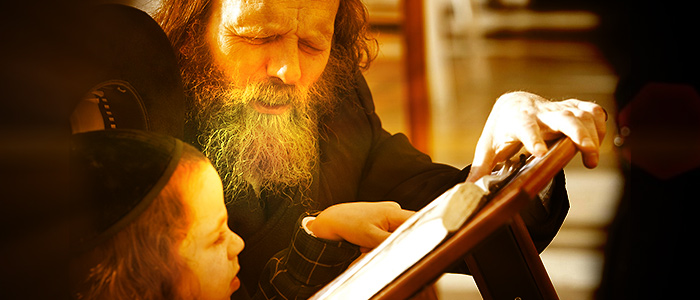
It is stated in tractate Eruvin (54b) that Rabbi Preida had a student whom he taught 400 times (he taught him each point until the student remembered it—Rashi's commentary). Once, Rabbi Preida told the student that he might have to leave in the middle of their studies to fulfill one mitzvah. In the end, however, he was not called away to do so. He taught the student 400 times, and the student still remembered nothing. Rabbi Preida asked him, “What happened?” The student replied that, knowing his teacher would soon have to leave, he had been unable to concentrate. He kept thinking that the rabbi was about to leave and abandon him in the middle of their studies. “All right,” said Rabbi Preida, “now concentrate, and I will teach you.” And he taught him another 400 times. Then a voice from heaven (a bat kol) rang out and asked him: “What do you wish—that another 400 years be added to your life, or that your entire generation merit the World to Come?” He chose for his entire generation to merit it, and then the Almighty said: “Give him both!”
This story is well known. But here is the question: how did Rabbi Preida know that this student needed 400 repetitions?
Surely, this is how it happened.
A Jewish man knocked on the rabbi's door with a question: he had a son in cheder who understood nothing of his studies. The other children were learning Mishnah and would soon begin Gemara, while he did not yet know Chumash. His classmates mocked him, the teacher practically ignored him, and there was no point in keeping him in school. He, the father, had already spoken to a shoemaker, who was willing to take the boy on as an assistant. But the head of the cheder had said that he needed to obtain the rabbi's blessing, so here he was.
“Bring him to me tomorrow,” said the rabbi.
The father brought the boy, a wonderful child—with the light gone from his eyes. “Leave him here,” the rabbi told the father. “Come back at lunchtime to collect him.”
The father left, and the rabbi stroked the boy's head and asked: “Can you read?”
“Yes, thank G-d.” “And are you already learning Chumash?” “Yes, we started learning Vayikra a while ago, but I didn't understand anything…” A tear rolled down his cheek.
The rabbi strokes his head again. “Let's begin. Sit down, and I'll explain it to you. Suppose a Jew commits a serious Torah transgression by mistake. For example, he gets up in the middle of the night and forgets that it is Shabbat—he mistakenly switches on the light to go and get a drink. And on Shabbat, you must not turn on a light, right? So he needs to bring a guilt offering. Wonderful. Now repeat what I told you.”
“Huh?… I don't remember,” the child said, embarrassed.
“That's all right, I'll repeat it.” Twice, three times, four times, a fifth time—nothing.
One can understand the teacher in the cheder, the head of the school, and the father. We repeat it a sixth, seventh, eighth time. “Let's take a break; play a little.” A ninth, tenth time—“Have a sweet.” “Now repeat what I said.” “I don't remember.” That's all right, we'll start again.
At lunchtime, the father arrives. The rabbi greets him with a broad smile, while the boy has a somewhat anxious look (now the rabbi will also say that he understands nothing…).
“What a wonderful son you have!” says the rabbi. “What persistence, what diligence! It is such a pleasure to study with him! Let him go home to eat and rest, then come back.”
After lunch, the boy returns. They repeat it thirty, forty times—nothing. Fifty, sixty—no progress. Seventy, eighty—a glimmer of understanding, but no more. One hundred—a brief break, and then we will start again.
Two hundred, three hundred—an impenetrable wall. Three hundred and fifty, sixty… Four hundred—and a triumphant cry: “Well done! You see—you can do it, you remembered everything! Let me write your father a note telling him what a bright son he has!”
And so it went—day after day, drop by drop… And what if he still had not learned it after 400 times? There is no doubt that Rabbi Preida would have kept trying...