Based on the books of Rabbi Eliyahu Eliezer Dessler and Rabbi Pesach Eliyahu Falk
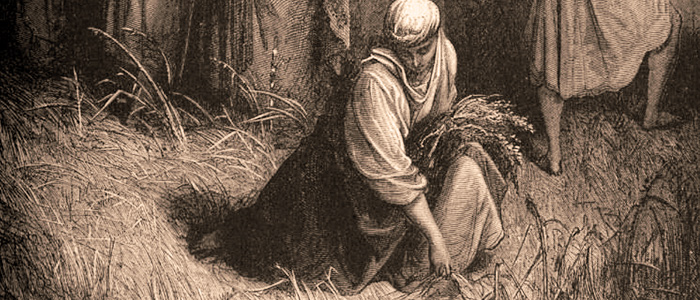
It is well known that Boaz married Ruth after noticing her modest conduct. Rashi explains that Boaz was struck by the way Ruth picked up fallen ears of grain—squatting rather than bending over. At first glance, this seems like natural behavior, and it is difficult to understand what impressed Boaz so much.
The answer can be found in Ruth’s own words: “I will glean among the sheaves behind the reapers” (Ruth, 2:7). She uses the preposition acharei. Our Sages of blessed memory explain that there is a fundamental difference between achar—“close behind”—and acharei—“at a distance.” Ruth followed the reapers, keeping a considerable distance so as to prevent undue familiarity with them.
Nevertheless, though she was far from the reapers and effectively alone, Ruth still took care to squat rather than bend over. This was what impressed Boaz.
Rabbi Falk (author of “Oz Vehadar Levushah”) uses this example to show that tzniut is a way of life that a woman should follow even when she is completely alone in her own home.
Ruth’s own story is remarkable. Moabite women are known in the Torah for their immorality and idolatry.
Yet she, a Moabite woman, managed to transform evil into good and thereby merited becoming the ancestress of Israel’s royal house, the ancestress of Mashiach! Was it necessary to choose a woman descended from Moab for such a lofty purpose? Was there really no worthy candidate among the daughters of Israel with an impeccable lineage and fundamentally different qualities rooted in her soul?
Jewish history offers many similar examples of people who, despite seemingly unfavorable beginnings, rose to extraordinary heights by transforming evil into good.
Our forefather Abraham grew up among idolaters and attained the highest level of holiness, sparks of which are present in all his descendants.
Moshe Rabbeinu spent his childhood amid terrible spiritual impurity, grew up on the lap of Pharaoh, who was himself an object of worship, and attained a level of prophecy that no one else ever reached.
The Jews were able to receive the Torah only after many years of slavery in Egypt, where they had descended to the 49th level of spiritual impurity.
How, then, can one overcome the conditions of one’s surroundings and rise above what is happening all around? Is it possible for a person to be unaffected by their environment?
Rabbi Dessler explains:
“A person’s surroundings inevitably influence them. But they do not necessarily change them. If they cannot change a person, their influence consists of strengthening that person’s convictions.”
If a person who firmly recognizes the truth is surrounded by wicked people, evil becomes repugnant to him, and he becomes even more steadfast on the right path he has chosen.
Thus Abraham our forefather, who was intimately familiar with idolatry, recognized all the impurity of what was happening around him and arrived at the idea of one Creator.
The reverse is also true. A wicked person living among the righteous can come to hate the truth in a way that other wicked people cannot. This is precisely what happened to Esau, who grew up in the home of two righteous people—Isaac and Rebecca. His descendant Amalek went to war against Israel solely because he could not bear the revelation of Truth that came through the Jews. Such a degree of wickedness is beyond an ordinary wicked person; only Esau is capable of it. Not only did he reject what Isaac and Rebecca tried to teach him, but precisely because of it he became so entrenched in his position that his descendants, throughout the generations, wage war against the Almighty not because they see value in idolatry, but because they hate the Truth.
Whenever, in Jewish history, the Almighty wishes to give a righteous person the opportunity to rise to a very high spiritual level, He places him in the most terrible surroundings, so that he will recognize the worthlessness of evil and attain a higher level of righteousness.
The Torah emphasizes that Abraham’s father was the idolater Terah, that Moshe Rabbeinu grew up in Pharaoh’s house, and that Ruth was descended from Moab... If they had merely escaped the influence of their surroundings, the Torah would not have mentioned it. Since it is written, it must be significant: they all attained spiritual heights not despite their origins, but because of them.
It was Ruth who became King David’s great-grandmother. Only a righteous woman who had preserved her righteousness amid terrible spiritual impurity could have been worthy.
This is relevant to us as well—those who came out of Soviet Egypt. We were brought up in an alien culture and read literature full of spiritual impurity, whose heroes we were taught to emulate… Now that the Almighty has brought us out of there, what should we do with all this baggage? Throw it on the scrap heap and try to forget everything? Or continue reading the same books (and watching the same films), telling ourselves that, of course, the characters do not always behave properly, but “how brilliantly it is written, what language—this is real literature”?
The Almighty sent us to that terrible country, just as He placed Moshe Rabbeinu in Pharaoh’s house and Ruth in Moab, so that evil would become repugnant to us and we could thereby transform evil into spiritual growth.
Having been brought up on the cult of Pavlik Morozov, we can attain a high level in observing the commandment to honor our parents and guard our tongues more carefully. Being familiar with classical literature, we can understand the terrible consequences of moral laxity and raise the spirituality of our family life to unprecedented heights.
Of course, this will not happen on its own. We need to study a great deal—more than those who grew up “in sheltered conditions.” But we also have greater potential. We will not, however, be able to use that potential if we simply forget everything (and can we?), much less if we leave a corner of our souls for these “values,” exposing ourselves to the risk of falling under the influence of evil.
Our children will thank the Almighty that they do not have this baggage (provided we do not “saddle” them with it), and will attain spirituality by a direct path.
We, however, should thank the Almighty for giving us this baggage, this potential for spiritual growth, and attain spirituality by the “method of opposites,” knowing how repugnant evil can be.
Prepared by Kh. Berman