Rebbetzin Yemima Mizrahi
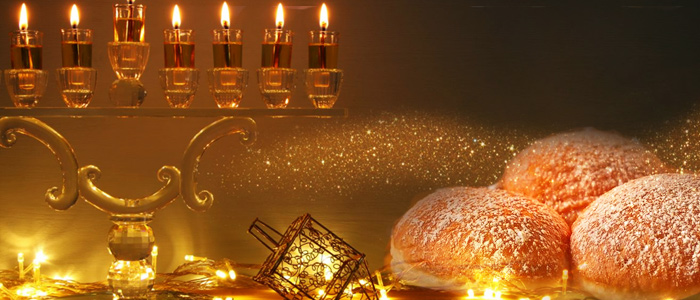
My Hanukkah gift to you—segulot from our sages for each day of the holiday:
On the first day, we light one candle and recite the blessing over lighting the candles. At the end, Ashkenazim say “Ner shel Hanukkah.” We should try to make sure the blessing contains 13 words, meaning that we should say either “Ner Hanukkah” or “Ner shel-ha-Hanukkah,” so that it is pronounced as one word. Thirteen words correspond to the 13 attributes of mercy, the 13 channels of blessing that descend to us from Above.
Our sages say that lighting Hanukkah candles is the only mitzvah for which an explanation appears right in the text: “These candles are holy, and we are not permitted to use them, but only to look at them.” Hanukkah is a holiday of chinuch, education. From this we learn that explanations matter, yet we sometimes forget to give children the most basic explanations. Sometimes teenagers lack the most basic knowledge about the Almighty—and are afraid to ask…
“Shehecheyanu.” “You have kept us alive, sustained us, and brought us to this day.” We have lived to see it! Yet how many people were still lighting candles last year and are no longer here. “Sustained us” is about food and having enough. “Brought us” (וְהִגִּיעָנוּ—from the word מגע, touch) is about touch, about people we could still embrace not so long ago. Rav Ben Zion Mutzafi said that the initial letters of these three words form the word chukah, law. These three words, like three blessings, will be fulfilled as a law in our home from year to year: we have lived, we have been sustained, we have arrived.
When you light the first candle,
think of everyone who is alone, who has not yet found a partner—and pray for them. Every single young woman can ask for her own “petach habayit,” doorway, her own home, her own family, in the coming year.
When you light the second candle,
pray for your marriage. We are together, and we are different. And that is a blessing. I had a “difficult childhood.” My father came from a Swiss family, and my mother was from Casablanca, Morocco. My grandmother Masuda could neither read nor write—and taught me to cut cookies out of dough. My other grandmother, Sarah Rothschild, was very intelligent and well read, taught Torah, and had published books. And I was always between them—between Yekkes (the name for people from the communities of Germany and Switzerland) and “hot peppers” (the name for people from Sephardic communities). I never felt that I fully belonged to either side, and this made me very sensitive and understanding toward any community. Being different does not mean being bad. We need to see another person in the light of their good qualities.
The third candle is about children.
As my Moroccan grandmother used to say, “Children will pull your ears out through your eyes.” Drawing on Rav Mutzafi, let us put it this way: one woman who advises on raising children will tell you that you need an “iron fist,” another a “soft touch”; one will say, “Overlook it,” another, “Punish.” And nothing works out. Nowadays, as soon as mothers see their children arguing, they rush to break it up. But then a child does not learn how to make peace! Let them argue, let them fight, so that they learn to ask forgiveness. Rav Mutzafi says: you are not a magician. Every child is different; it is impossible to give to everyone at once in a way that leaves no one hurt. But there is one segulah: pray for your children when lighting the third candle. It works.
On the evening before Shabbat, when the Hanukkah and Shabbat candles are lit, it is time to pray for your children's marriages:
Samchem bevinyan shalem, “Gladden them with a complete (whole) home.” The Sefat Emet says that on the Shabbat of Hanukkah, one should recite the verse “Samchuni ba-ashishot” (Song of Songs, 2:5): “Sustain me with fruit pastilles, refresh me with apples, for I am sick with love.” Ashishot is twice esh, two fires: the Shabbat and Hanukkah candles, which can heal us.
The fourth candle—
is the candle of motherhood in its aspect of caregiving. Here there are two possibilities: either a woman looks after her own children (staying within 4 amot), or she goes “out into the world”—in all 4 directions. Every woman has this inner battle. And every woman swings from one to the other. On the one hand, she wants to be at home, feed her children homemade food, do things together with them. But after two hours she wants to run away from them, attend to her own affairs, look at people without lowering her head… At the fourth candle, we ask for balance, for harmony between these two aspects of womanhood.
Five candles—
a time when there are more burning candles than darkness. This is the time to ask for optimism, for a positive outlook on life. And also—the Chumash, the five books of the Torah: you can ask for the desire to study Torah and a love of its study.
The sixth day—
shishah sidrei Mishnah. The Mishnah is the art of deriving laws. Here you can pray about art, about your own abilities, about your children's talents.
The seventh candle—
first of all, pray for the Temple, which housed the Menorah with seven lamps. And ask for joyful Shabbats.
The eighth candle...
Eight is a number beyond our understanding, beyond nature. On this day, all prayers are accepted. Each day of Hanukkah is the day of one of the tribal leaders (who brought offerings). The eighth day is the day of Ephraim, who was the younger brother but received the older brother's blessing (because his grandfather switched his hands). It is a day when someone small can receive much. On this day, “Zot Hanukkah,” we pray for the childless, reciting a verse from Psalms (80:14,15): “G-d of Hosts! Return, please, look down from heaven and see, and remember this grapevine.” We ask especially for a son, because the Greeks forbade 3 things: Rosh Chodesh (the new month), Shabbat, and milah (circumcision). There is always a Rosh Chodesh and a Shabbat during Hanukkah. And we pray for a brit milah on the eighth day. The Ruzhiner Rebbe says that on the eighth day of Hanukkah, a person can achieve through prayer what he could not achieve in the “Ne'ilah” prayer on Yom Kippur!
And a segulah from the Chatam Sofer that I have heard much about:
stand facing the candles on the last day and cry so much that you cannot tell how many candles are burning—and pray for deliverance.
Another wonderful segulah:
immediately after lighting the candles, recite the verse from Psalms (90:17): “May the favor of the L-rd our G-d be upon us, and establish the work of our hands for us, and establish the work of our hands.” Then repeat all of Psalm 91 7 times. The Rebbe of Slonim explains that we usually recite this verse before performing a mitzvah. Here, however, we want the reverse—miketz—to begin at the end, a new beginning, so we recite it after the mitzvah.
The Rambam's father said that eating doughnuts fried in oil, called sfenj, is a segulah for prosperity throughout the year.
What is sfenj? It has a particular feature: when it is fully cooked in a deep pool of oil, it flips over. So it is with you: when you feel “done,” there will be a turn for the better.
Give children Hanukkah gelt.
Each time, we think: what if he is not responsible enough, loses it, or spends it on foolish things! Give without a second thought, and then the Almighty will also give to us, despite our irresponsibility.
A candle resembles a cholam (וֹ—spelled out as חולם, it is the letter “vav” with the vowel “o”). You can sit facing the candles and dream (chalom—a dream). You can dream of what you desire most, even what seems impossible—and you will see it with your own eyes. Rav Sacks says, in this connection, that there is one word that is often negative in the Tanakh: vayehi —“And it came to pass.” This word signifies the passive course of events; we change nothing in them. Stop being a vayehi woman, passively watching everything happen around her. Be a woman of yehi, lu yehi (may it come true; the gematria of lu is 36, the same as the number of Hanukkah candles), and the candle will remain the letter vav.
Prepared by Mrs. Zissi Skarzhinskaya