Rabbi Mendel Agranovich
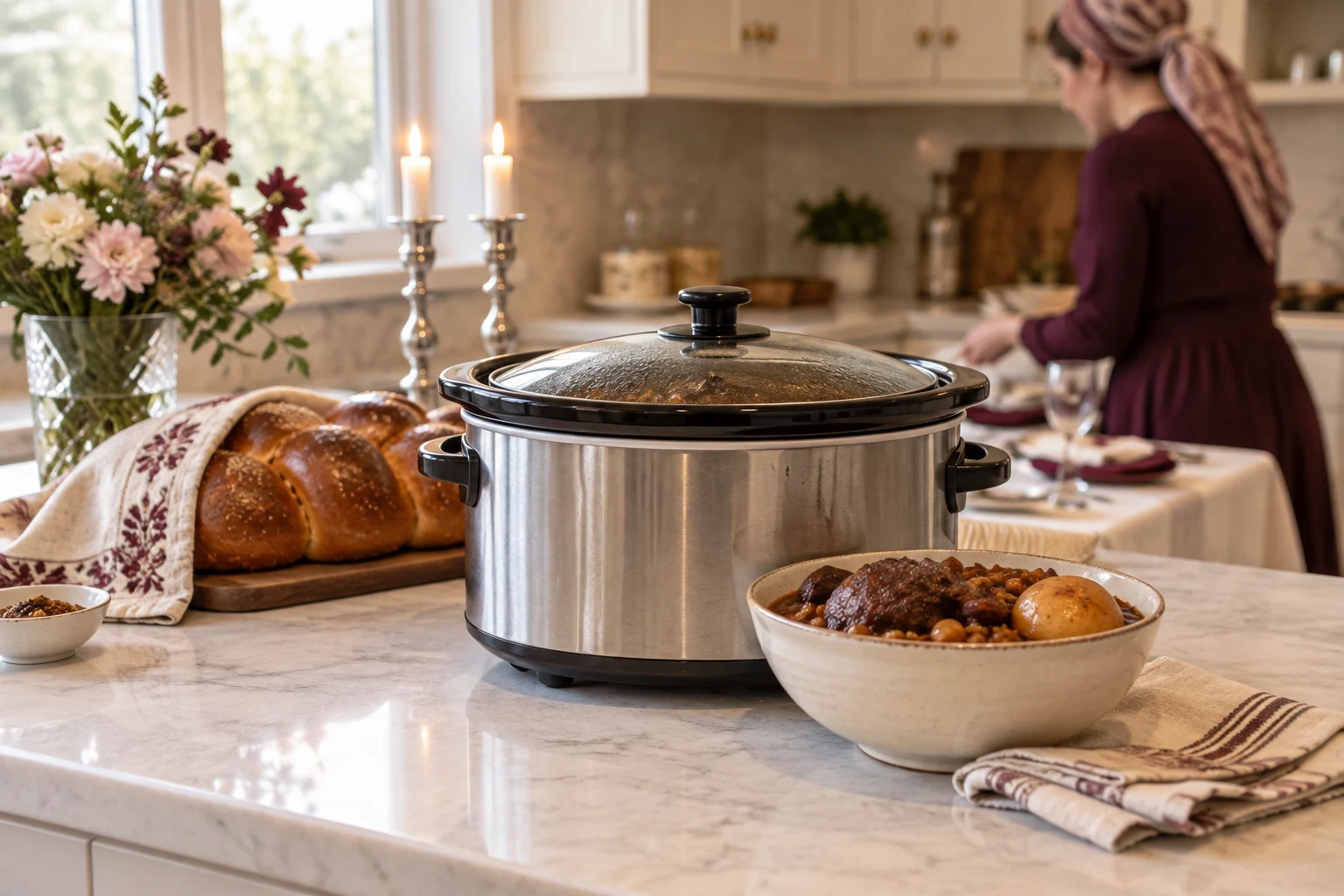
When do we encounter situations in everyday life that involve the prohibition against insulating food? Not everyone wraps their pot in towels, so it may seem that this prohibition has little relevance to us. In fact, however, modern technology does use the principles of insulation in the operation of kitchen appliances. Let us give two examples and discuss them.
Example No. 1. “Crock pot”
A pot known by its English name, “crock pot,” used for slow cooking. This appliance was invented in response to a family's need for a hot meal at the end of the working day when the homemaker is away from home all day. Food cannot burn in this appliance; the ingredients can be put in in the morning and left for the entire day. In the evening, the homemaker comes home and has a hot dinner ready immediately, without any further preparation.
The appliance is constructed as follows: a ceramic pot is placed inside a larger-diameter metal pot that fits closely around it. There is a heating element beneath the bottom of the metal pot. The heating element has two power settings—“High” and “Low.”
This pot became popular in the United States and Canada among observant Jews for preparing cholent for Shabbat. Cholent made in such a pot was tender rather than overcooked, with the flavor of a home-cooked pot roast. The ingredients are put in on Friday, and the “crock pot” is left switched on until the second meal (it should be clarified that the appliance is switched off on Shabbat by a “shaon Shabbat”—a Shabbat timer).
Several halachic questions arose regarding the use of this appliance.
May food be left in a “crock pot” for Shabbat? Does it fall under the prohibition against leaving food on the fire before Shabbat?
In this appliance, only the inner pot has a lid. The outer pot is the heating element. Does this count as insulation that adds heat?
If this is insulation, is it partial or complete?
May the ceramic (inner) pot containing cholent be returned to the metal (outer) pot during Shabbat? Does this action fall under the prohibition against returning food to the fire?
How can all these problems be avoided so that such a pot can be used in a permitted way?
It should be noted that the walls of the outer pot run close to the walls of the inner pot along their entire height, but do not press against them the way blankets do, for example. The ceramic (inner) pot has a lid, but nothing covers that lid. The authors of “Orchot Shabbat” write that the gap between the walls and the pot is approximately 2 mm. There are several other models in which the inner pot extends a few centimeters above the outer pot. There are models with heating elements in the walls, while others have them at the bottom. There are also models with heating elements both in the walls and at the bottom.
May food be left in a “crock pot” for Shabbat?
This type of appliance is considered an uncovered heat source, so food may be left in it only if it is at least one-third cooked; ideally, it should be fully cooked, as we wrote in our previous articles.
Does this appliance fall under the prohibition against insulation?
In other words, does placing one pot inside another whose walls or bottom contain heating elements count as insulation?
In principle, this more closely resembles the arrangement of “burying a pot in earth with coals,” described by rabbis of different generations since the time of the Talmud. A pot was placed in a hollow containing burning coals and soil. When necessary, the coals were stirred, raising the temperature around the pot. This method of retaining heat was prohibited on Shabbat out of concern that a person might stir the coals out of habit. Because of it, all forms of insulation in materials that add heat were prohibited.
A “crock pot” both adds heat and allows it to be increased using the power control—like coals that can be stirred. At first glance, this is prohibited insulation.
But, as we remember, there is the concept of “partial insulation,” when part of the pot remains uncovered. According to the Shulchan Aruch and the Chazon Ish, partial insulation is prohibited, but according to the Rama and the “Mishnah Berurah,” the accepted practice is to be lenient (see the previous article).
The lid of a “crock pot” is not covered by anything on top, so it can be said that this is only partial insulation, which is permitted according to the Rama.
The rabbis of our generation have disagreed about how to understand the Rama's opinion: what, in his view, constitutes partial insulation. The author of “Pri Megadim,” Rav Yosef Teomim, also raised this question. Rav Moshe Isserles (the Rama) expressed his opinion as an objection to the author of the Shulchan Aruch, who wrote that a pot may not be placed on coals even if only its bottom touches them. According to Rav Yosef Karo (the Shulchan Aruch), this already counts as insulation.
The Rama, however, held that whenever the pot is not covered on top, there is no prohibition and the accepted practice is to be lenient (see the end of section 253,1).
The “Pri Megadim,” then, was unsure what the Rama considers partial insulation:
– a pot with only its lid uncovered,
or
– a pot with a substantial portion of its sides and lid uncovered.
In addition, the authors of “Orchot Shabbat” hold that whenever the insulation consists of materials that generate heat on their own, it makes no difference whether the lid is covered by the material or not. The insulation is sufficiently effective even with the lid uncovered, because the heat supplied by the sides and bottom is much greater than the heat lost from the top. In that case, based on what is stated in “Pri Megadim,” it falls under the prohibition against insulation even according to the Rama.
Another important question: we wrote that the two pots fit one inside the other, with a gap of only 2 mm between them. On the other hand, the insulating material must be in contact with the pot or the food; otherwise, it is not insulation. In the case of our “crock pot,” does this gap take it outside the definition of insulation or not?
The opinion of the Rosh (Rabbeinu Asher ben Yechiel) and the Tur (Rabbeinu Yaakov ben Asher, the Rosh's son) on this question is as follows: even a small space separating the pot from its covering takes it outside the definition of insulation, which requires close contact. But in our situation, where the entire setup is an insulating appliance specifically designed to heat through this air gap, it may be possible to disregard the gap, since it makes little difference to the insulation—that is, it does not reduce the heat, and so on. This is what Rav Shlomo Zalman Auerbach wrote in his reply to Rav Yitzchak Mordechai Rubin, one of the authors of “Orchot Shabbat.”
So, the Practical Conclusions
Food that is less than one-third cooked may not be left in a “crock pot.”
Ideally, the food left in it should be fully cooked.
To return the inner pot containing fully cooked food to the “crock pot,” while observing all the rules for returning food to the fire, the inside of the outer pot (the heating element) must be lined with something, such as a sheet of heavy-duty foil. The “fire” will then be considered covered.
To ensure that the inner pot is not considered completely insulated, it must be raised off the bottom by placing a metal plate on the bottom or cubes at several points, so that part of its sides extends above the rim of the outer pot. Some people use metal cubes from the children's game “five stones” for this purpose, each 1 cm high. They rely on the opinion of Rav Shmuel Wosner, who holds that this can be considered partial insulation, which is permitted according to the Rama, and that the stones are a desirable but optional stringency. However, the authors of “Orchot Shabbat” hold that most of the pot's surface must be above the rim of the outer pot's walls, so the cubes must be much taller.
Rav Shlomo Zalman Auerbach held that a third metal pot should be inserted between the ceramic pot and the metal pot containing the heating elements. Pots of this kind made of heavy-duty foil are available.
All these ways of permitting its use apply only to Ashkenazi Jews who follow the Rama's opinion.
Example No. 2. Multicooker
A multicooker is similar to a “crock pot,” except that the lid is on the outer pot rather than the inner one. Another pot, in which the food cooks, is inserted into the pot with the lid. A multicooker can be programmed for several modes and can also delay cooking for up to 12 hours.
According to the definitions given by the authors of “Orchot Shabbat,” food may not be left in it for Shabbat under any circumstances, since even according to the Rama this is complete insulation. The only option is to switch it off before Shabbat and leave it closed. In my experience, it retains heat very well until the end of the first meal. Blankets or towels can be added if necessary. It must be wrapped in them before Shabbat so that the food stays warm longer.