Rebbetzin Chava Kuperman
So, let us continue explaining Shmuel’s instructions. Recall that the people mentioned in the verses fall into three groups, as shown in the table:
| № | Who these people are, how many there are, and what characterizes them | Where these people are | Their relationship to Shaul |
| 1. | Two men | Near Rachel’s tomb | They will speak to Shaul about the female donkeys |
| 2. | Three men One is carrying three lambs. The second—three challah loaves. The third—a vessel of wine. | They are all going to the House of G-d | Gives Shaul two challah loaves |
| 3. | A group of prophets | The hill of the Almighty | Shaul must join them and prophesy as well |
In the first row of the table, the two men symbolize the basic level of our people, the two opposing natures that exist within each of us.
Essentially, these are two kinds of inclinations, or preferred pleasures.
The first is the desire to satisfy an appetite; once satisfied, a person remains content for a while (these are physical pleasures—food, sleep, sweets, alcohol, and so on). The second is a desire that can never be fully satisfied (for money, power, honor...). Both types of desire can be used for good or for ill. Without a sense of limits, both acquire a “minus” sign.
The credo of the first type of desire is: feel good now, and inevitably feel bad later.
(For example, I like chocolate. What a tremendous pleasure it is to savor its distinctive taste! I want as much chocolate as possible! A whole bar! No, two! Better yet, a kilogram of chocolate! …But yes, I know that after eating that kilogram of chocolate... I’ll feel sick. For a week, perhaps even a month, I won’t be able to look at it... But it feels good now!). This is the realm of passions. Here, whenever there is no moderation, it feels good now and is bound to feel bad later.
The credo of the second type is: feel bad now, but good later.
Right now, you have to work hard, go without sleep, miss seeing your family, and take no rest. But you are certain that later everything will be wonderful — such is the realm of power, money, and honor… (Here, people work hard for the future, living entirely for tomorrow, while those of the first type live entirely for today: I have everything now, and who cares what comes next!).
These two types also symbolize East and West.
The East means pleasure, relaxation, an unhurried pace, and a desire to live for today; in the West, everyone is rushing about, making money and pursuing fame, honor, and so on.
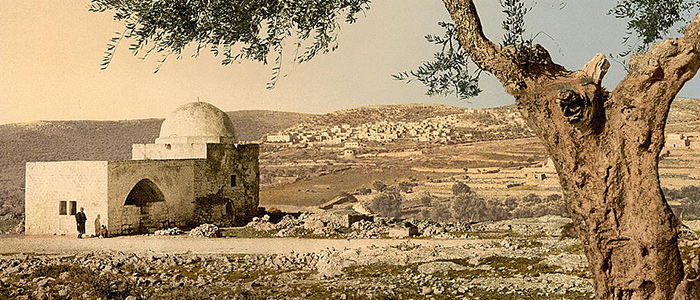
These two men are now at Rachel’s tomb, burying their souls. (Rachel symbolizes the soul.)
The group in the next row consists of those going to the house of the Almighty. They are not there yet, but that is where they are heading.
The first of them wants nothing physical; he is carrying lambs intended for sacrifice and seeks to give the Almighty everything he has.
The second man is also going to the House of the Almighty, but he understands that everyone needs bread; bread is the bare minimum without which one cannot live. This type of person symbolizes the part of the Jewish people that will be Shaul’s main support. The two loaves represent the 2000 people who will follow him.
The third type in this same row consists of those going to the house of the Almighty with a wineskin in tow. People of this type always want to derive pleasure from everything. They will give Shaul nothing.
And there is the final group in the last row: those already on the hill of G-d, who have reached their goal. Shaul must join them and be like them.
It says that the last group will include prophets with musical instruments—the gates of music and the gates of prophecy are considered the gates closest to one another.
In several places in the Tanakh, we encounter prophets with musical instruments nearby. Perhaps this is because music lifts the spirits, and one cannot receive prophecy in a bad mood. For example, the Second Book of Kings (chapter 3, verses 4-15) describes a historical moment when, after an extremely unpleasant incident, the prophet Elisha is unable to prophesy; he asks for a musician to be brought to him. The musician is brought. The gift of prophecy returns.
A few brief additions.
The hill of the Almighty is the hill where the Ark of the Covenant is located.
By the time Shaul meets the first two men, they will no longer be at Rachel’s tomb, but in Zelzah. What does the name of this place tell us? There are many commentaries on this. Rashi explains that it refers to Jerusalem. Why? Because tzel means “shadow,” and tzach means “bright” or “clear.” The bright and clear one is the Almighty. (For example, in the Song of Songs, the same word appears in the verse that says: “My beloved is radiant and ruddy”—chapter 5, verse 10.) This refers to the site of the Temple, since Jerusalem is the place where the shadow of the Almighty is found.
Everything listed here is intended for Shaul for a reason: he is a descendant of Binyamin. It is a shadow of the promise the Almighty made to Yaakov just before Binyamin’s birth: “Kings will descend from the one about to be born.”
The last of Shmuel’s instructions to Shaul is as follows: “Go down ahead of me to Gilgal, where I too will come down to you to offer burnt offerings and peace offerings. Wait seven days until I come to you and tell you what you are to do” (chapter 10, verse 8). This refers to something that will happen about a year later. An extremely difficult test awaits Shaul, one faced by each of us and by the Jewish people as a whole. The moment we pass this test, and pass it entirely correctly, the whole world will be rectified. This is about the ability to wait for as long as has been prescribed. Future well-being depends on this ability. (Shaul will fail to wait the full seven days and will act hastily; this will be described in chapter 13, verses 8-14.)
Humanity’s first sin was that Adam ate the fruit of the Tree of Knowledge before the appointed time.
Had he endured the wait, had he waited until Shabbat began, he would have received this fruit in the form of wine or bread. (According to one opinion, the forbidden fruit was wheat; according to another, grapes. Now, to atone for the first sin, we are forbidden to eat the fruit of young trees for three long years.)
Impatience is our gravest sin and the hardest to correct. We see countless examples of this.
While preparing to receive the Torah at Mount Sinai, the people rise to the level of the first man before he sinned, but, failing to wait for Moshe, they fall—they make the Golden Calf early in the morning, when only a few hours remain until Moshe’s arrival.
And this repeats itself throughout the centuries.
We do everything right, just at the wrong time: either too early or too late. The desire to do everything whenever we want is deeply and firmly rooted in us.
Now (a year later), Shaul is given the opportunity to correct the sin of impatience, but he lets it slip away. This is an extremely difficult test, which he fails. In every other respect, everything is wonderful. It says that when Shaul turned away from Shmuel, he seemed to become a different person, filled with strength. He was given additional qualities of courage and authority. (Each of us sometimes feels capable of moving mountains; Shaul was given this inner strength.)
He reaches the hill of the Almighty, meets the prophets there, and becomes one of them.
When people who knew him before arrive there, the changes in him astonish them. He is a prophet? But to become a prophet, one first had to study at a school (a yeshiva), where intellect and logic were developed, and then attend a special school for prophets, where imagination was developed. This rule had always applied to everyone. There had never been a case of someone simply receiving the gift of prophecy without preparation, when neither his father nor his mother was a prophet.
(There is an expression in Hebrew: “What, is Shaul a prophet too?” This is said when someone displays qualities that no one would ever expect of him.)
Shaul continues on with his servant and meets his uncle. His uncle asks where they have been. Shaul tells him that they visited Shmuel, who said the female donkeys had been found. Not a word about his having been anointed king.
All of Rachel’s descendants are like this. Binyamin, Shaul, and Esther are all modest; they “hold the spindle of silence,” saying nothing unless there is a particular need. They are by no means lacking in eloquence and are quite capable of speaking well, yet they do not speak. Their silence is loud.