Rebbetzin Chava Kuperman
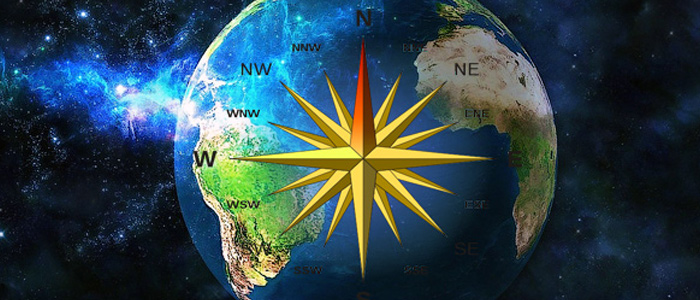
The four directions correspond to the four-letter Name of the Almighty, the four species of plants we wave on Sukkot, and four colors—black, white, red, and aquamarine (green-blue-yellow).
They also correspond to the four sides of the camp, that is, the way the Jews encamped in the wilderness; the four elements of the world (fire, water, air, and earth); the three Patriarchs—Abraham, Isaac, and Jacob—and King David (the beginning and end of the Jewish people's emergence, potential and its realization); and the four sins—idolatry, incest, bloodshed, and malicious speech—which are also mentioned in the prophecy.
In analyzing the significance of groups of four, we mentioned the four directions.
G-d created this world with four sides, and the world's unity is impossible if one of its sides is missing. We affirm this every day as we conclude the bedtime Shema: “In the name of the L-rd, the G-d of Israel: to my right is Michael, and to my left is Gabriel, before me is Uriel, and behind me is Raphael, and above my head is the Shechinah of G-d (the Divine Presence).”
These angels are believed to stand before the Almighty's throne and guard the four directions.
If we remember that we Jews face east rather than north, it becomes clear that Michael is the angel of the south, Gabriel the angel of the north, Uriel the angel of the east, and Raphael the angel of the west.
Three of the four directions have clear parallels with particular mammals.
The east is the lion, the south is the human being, and the west is the bull. The north is a variable, ambiguous concept. When we speak of the Almighty's throne, the north is symbolized by the eagle. When we speak of the tribes of Israel, the north is symbolized by the serpent. The eagle is foremost among birds, and the serpent is foremost among reptiles. Unlike the other three directions, which are symbolized by mammals that give birth to live young, the north is symbolized by a reptile.
(Some reptiles also give birth to live young, but this is an exception; the main point is that reptiles are on a lower level than the rest of the animal kingdom.)
Here we encounter the concept of four kings.
The lion is the king of wild animals; it does not need to do anything to establish itself on the royal throne—it simply lies there, and everyone fears it. The lion represents the east. This is the direction from which sunlight and warmth first break through. But a harmful wind (a hot, dry wind) also blows from the east. The tribe of Judah, supported by Issachar and Zebulun, counters its destructive influence. They protect the entrance to the Mishkan, which is on the eastern side.
The bull is the king of domestic animals. It represents the west. Incredible, terrifying, animal strength! An enraged bull can kill a lion. (Think of the bulls in bullfights.) Yet unlike the lion, which lives in the wild, the bull, with all its strength, has been completely tamed. On the western side, the Mishkan is protected by the tribes of Benjamin, Ephraim, and Manasseh.
The south is the human being, the creature that stands above all of nature.
The south is hot and red in color. People from the south are considered warm (the most sociable and responsive), but passions often rage within them. Thus, the south is also a symbol of sin. Where there is sin, there is shame. Among other things, the color red symbolizes shame.
The south encourages self-improvement, teshuvah. The southern side of the Jewish camp in the wilderness is the tribe of Reuben, supported by Simeon and Gad. Reuben is a symbol of teshuvah.
The north is the side the sun never reaches: dark and unfinished. Everyone has their own north; we have spoken about this many times.
But the north is also considered the most important direction. Having created us, the Almighty expects each of us to correct our own "north"—to complete what is unfinished and work on our character traits. Everything we must correct within ourselves is symbolized by the north...
These are all fairly complex matters. Explaining them in detail requires extensive study and immersion in the Zohar and other sources. That is beyond our scope, so let us return to our discussion of the Book of Zechariah.
to be continued