Miriam Gershgorn
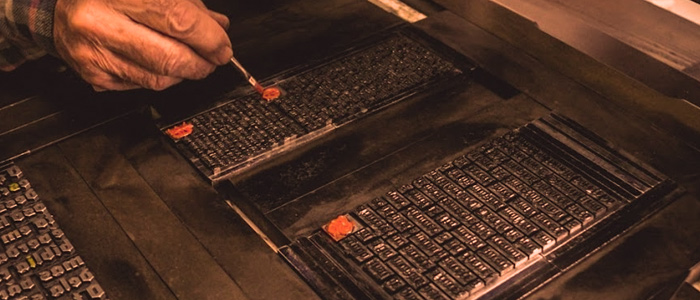
In the days when Bnei Brak was not yet considered a full-fledged city, a modest Jew named Reb Shloime Cohen lived there. He was not a rabbi; he worked for a living and studied daily in chavrusa with the Chazon Ish. Reb Shloime himself was originally from Vilna, and he had maintained his connection with the Chazon Ish from those days.
Reb Shloime owned a small printing shop. In those days, not every young Torah scholar about to marry published a book of his own, but Reb Shloime managed to earn a living in the printing business. The printing presses of those days were what you would expect—old; printing was a lengthy process, words had to be assembled from metal letters and arranged evenly in a boxlike typesetting frame. So when a book finally came off the press, its author would buy himself a new outfit or put on his Shabbat clothes, eat a fruit he had not yet tasted that year, and recite “Shehecheyanu” to fulfill his obligation according to all opinions.
In a word, publishing a book—gathering all the commentaries, searching through the shelves, checking everything, obtaining approbations, and so on—was a major event, and sometimes the work of a lifetime.
Then one day, Reb Shloime saw enormous machines being unloaded from trucks across the street from his printing shop.
Reb Shloime went over and learned that another Jew was planning to open a printing shop directly opposite his own. Reb Shloime looked at the equipment being unloaded and began offering the man advice:
- return these enormous machines and order smaller ones; they are much easier to repair and maintain
- this paper is very expensive; in Bnei Brak, a simpler option is quite sufficient
- here is the phone number of a supplier of inexpensive ink
- and here are the contact details of someone who repairs printing presses... and so on.
And Reb Shloime, drawing on his expertise, began giving his competitor helpful advice on how best to set up his business.
At first, the man was bewildered by such generosity and even thought that Reb Shloime might be deceiving him in an attempt to get rid of an unexpected competitor.... But when the “competitor” checked the addresses and contacts himself, he realized that all the advice was sound, useful, and would save him money.
Reb Shloime's wife, who had been watching from the sidelines, asked her husband at home: “All right, suppose all parnassah (income) comes from Above, and so does the opening of new businesses. But where does halachah say that you must go and tell someone else all the secrets of your own business?”
“I don't understand you, my dear,” Reb Shloime replied in surprise. “If all my income has already been determined, what difference does it make where that money comes from? And if I am destined to print 30 books a year, then the Almighty has sent me a helper who will do half the work. After all, I will receive what I am meant to receive anyway. The only question is—how much work will I have to do?!
And if the Almighty has sent someone who will do half that work, shouldn't I help that person?!”
...It is known that one of the appendices to the Chazon Ish's book “Faith and Trust” contains a letter in which the sage does not say this outright, but hints very clearly that if a person truly believes that all parnassah comes from Above, he will see a competitor in the same field as a helper sent to him to ease his burden and halve his workload, rather than the other way around.