Rebbetzin Chava Kuperman
Chronologically, the prophet Amos came after Hosea. He was wealthy and came from the tribe of Asher, whose symbol is olive oil and abundance.
We have a tradition that Amos was not eloquent.
(Isaiah was the only prophet who spoke well; he lived in the capital and had a dignified presence. The flawless delivery of his prophecies left no room for criticism. However, this did little to help the prophet: people beat him and pulled his beard just to silence him. They did not want to listen to him, because he said unpleasant things.)
All of Amos's prophecies are also extremely grim. Chapter 6 of his book, verses one through seven, describes how corrupt the people had become. Indeed, during this period the Jews had forgotten G-d. They feel wonderful, treat one another very well, and are concerned with nothing except obtaining new and increasingly sophisticated and refined pleasures.
Chapter 9 of the Book of Amos is read in Ashkenazi communities as the haftarah for the Torah portion Kedoshim (not according to all opinions).
Chapter 7 of the Book of Amos contains a prophecy about the coming exile and devastation of Israel (which we briefly mentioned in the previous article).
Amos's contemporary Amaziah, who was the chief prophet of the idol worshippers, hears about this. He immediately runs to Jeroboam the Second, demanding that he punish the “conspirator” who is sowing confusion in his subjects' minds. Jeroboam rejects the accusation and dampens the informer's zeal (“If he says this, it must be what G-d told him”). Amaziah then tries at least to taunt Amos: “So what are you doing here? Go south, where the king of Judah will feed you and listen to your prophecies, and don't tell us about all these horrors here...”
Jeroboam puts a stop to these taunts; Amaziah is eager to punish Amos but cannot do so without the king's permission. Amos says: “I am not a prophet, and my father was not a prophet” (indeed, Amos's father's name is not given anywhere, which confirms the truth of his words).
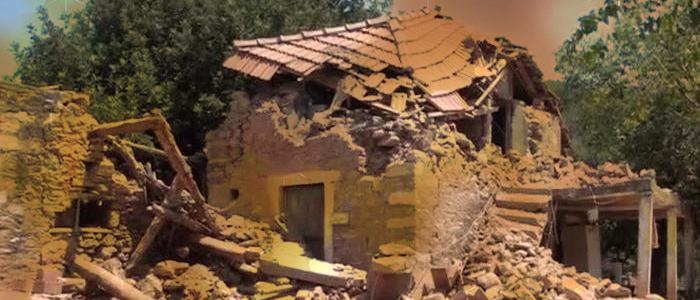
It is known that Amos began prophesying two years before an earthquake that is mentioned in one other place in the Book of the Minor Prophets—by the prophet Zechariah (chapter 14, verse 5): “And you will flee to the mountain valley, as you fled from the earthquake in the days of Uzziah, king of Judah.”
People often ask: which earthquake is being referred to?
There is a tradition that it occurred in Jerusalem during Uzziah's reign and caused terrible destruction. “Divrei Hayamim”—the Book of Chronicles (Book 2, chapter 26, verse 16 onward)—states:
“And when he /King Uzziah/ became very arrogant, he decided to go up himself and enter the Temple to offer incense. Then 80 strong kohanim stood against him and said: ‘You have no right to do this. Only kohanim, the descendants of Aaron, may do this.’ And he was very angry. He had a heavy censer in his hands. He wanted to drive the kohanim away, but at that moment leprosy appeared on his forehead. He had to leave not only the Temple courtyard but even Jerusalem, and he lived on the Mount of Olives and could not rule”.
On a certain level, King Uzziah displayed an improper, demeaning attitude toward the House of the Almighty. And, as the tradition tells us, that very earthquake occurred at precisely this moment.
Chapters 1 and 2 of Amos's book have a distinctive style. He lists the nations and says that each has three sins the Almighty is willing to forgive, but a fourth sin He will under no circumstances forgive. The haftarah for the Torah portion Vayeshev (the sale of Joseph) is precisely the second chapter of the Book of Amos, which says: “...I will not forgive them for selling a righteous man for money and a poor man for shoes.” According to one opinion, after selling Joseph into slavery, the brothers used the proceeds to buy themselves shoes.
There is a tradition that from the creation of the world until the coming of the Messiah, the earth will be ravaged by terrible famine ten times.
This has already happened nine times. The tenth is mentioned in the Book of Amos (chapter 8, verse 11) as follows:
“Behold, days are coming,” says the Almighty, “when I will send a famine upon the earth. Not a hunger for bread or a thirst for water, but a hunger to hear the words of the Almighty.”
The end of the Book of Amos describes what will happen when the Messiah comes. The Land of Israel will become very fertile.
To be continued