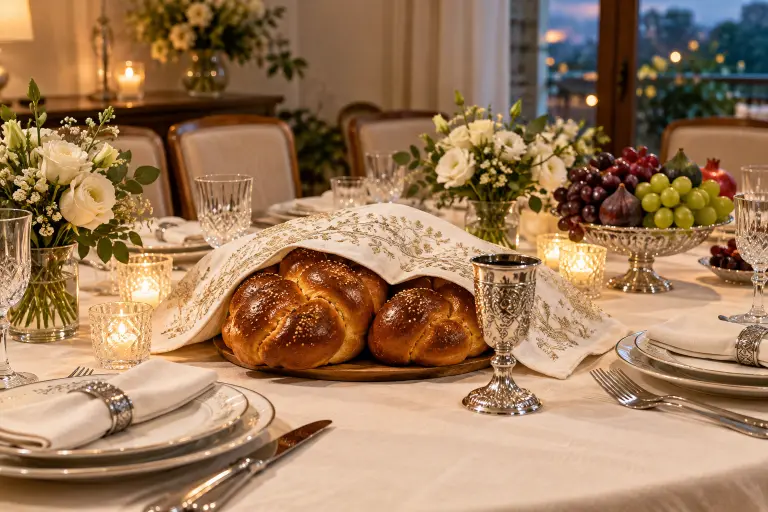
The week after the wedding is called the week of Sheva Brachot (Seven Blessings).
This is a unique festive period with deep spiritual roots that entirely takes the place of the familiar secular concept of a “honeymoon.” Instead of going away on a trip alone, the newlyweds remain among family and community, and each of the seven days becomes a small celebration of its own. This week is governed by strict halachic rules and beautiful traditions:
Daily Festive Meals
Each day during the week, relatives, close friends, or the community host a festive meal in honor of the bride and groom. The wedding banquet counts as the first day. At the end of each such meal, immediately after the Grace After Meals (Birkat Hamazon), the same Seven Wedding Blessings that were recited under the chuppah are recited again.The “New Guest” Rule (Panim Chadashot)
For all seven blessings to be properly recited at a meal at home, two conditions must be met:• A minyan must be present (at least 10 adult men).
• At least one “new face” (panim chadashot) must be present. This must be a guest who has not yet attended the wedding itself or the previous days of Sheva Brachot. The arrival of a new person is considered to “renew” and heighten the shared joy. On Shabbat, this rule does not apply—the holiness of Shabbat itself automatically counts as a “new face.”
The Ritual of Mixing the Wine
As under the chuppah, the blessings at these meals are recited over a cup of wine. Usually, two cups are used: one for Birkat Hamazon and the other for the wedding blessings. At the very end, the wine from both cups is mixed together and poured for the newlyweds. This is a beautiful symbol of the fact that their destinies and lives are now inseparably joined.The Prohibition on Work and Mourning
According to the Shulchan Aruch, throughout the week of Sheva Brachot, the bride and groom should not work, conduct business, or attend to everyday matters. Their main obligation during these days is to rejoice, dress up, and spend time together. During this period, the newlyweds are also prohibited from taking part in mourning ceremonies, so that nothing clouds their complete happiness.
Note: If this is a subsequent marriage for both spouses, the Sheva Brachot period is shortened—meals with blessings are held for only three days (and the 7 blessings themselves are recited only on the wedding night).