Fröken Brokh
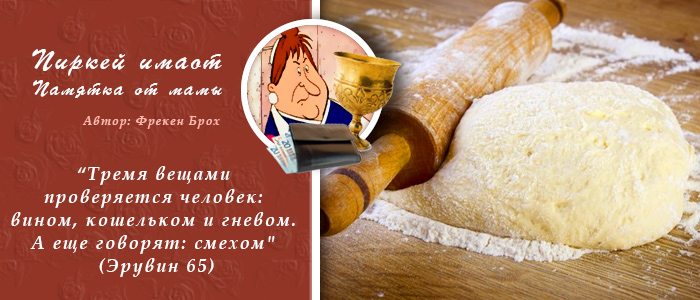
Before Pesach, we clear chametz out of our home. According to our Sages, chametz is nothing other than pride. Pride rises within a person as if leavened by yeast…
Here is a wonderful story about Rabbi Jonathan Eybeschutz, illustrating how long we must continue working to overcome pride.
Rabbi Jonathan Eybeschutz once spent Yom Kippur in a Jewish shtetl. At the evening service, one of the prominent members of the community prayed with deep feeling: “I am dust in my lifetime—all the more so after my death…” He was in tears, and repentance could be heard in his voice. Rabbi Eybeschutz noticed his prayer, admired it inwardly, and remembered it.
The next morning, this prominent man was not called up to the Torah. He became terribly angry and began shouting at the synagogue's gabbai, berating him and hurling the worst insults at him.
Rabbi Eybeschutz decided to intervene. He approached and said, “Didn't you pray with such feeling yesterday, ‘I am dust in my lifetime…’? That implies humility. There is no need to be so indignant.”
The man replied, “I was praying—speaking before the Almighty. Before Him, of course I am dust. But before this gabbai! He is far more dust than I am! He is worse than dust!”
Then Rabbi Eybeschutz exclaimed, “Now I understand the words of the Gemara. It is written that what Moses and Aaron said was on a higher level than what our forefather Abraham said. Abraham said, ‘I am dust and ashes,’ while Moses and Aaron said, ‘What are we?’ Abraham spoke these words before the Almighty, while Moses and Aaron spoke before the entire people. They felt humble before every member of the people of Israel.”