R. M. Levi
Based on lessons by Rabbanit M. Levi (daughter of Rabbi Shimshon Dovid Pincus)
There is an interesting question concerning the laws of the Temple that the Sages discuss. A kohen betrothed a woman using sacrificial meat instead of a ring. Did she become his wife? It is known that the object with which a man betroths a woman must meet two conditions: it must have value and belong to that man. If the object does not belong to him, the woman does not become his wife. Does the sacrificial meat belong to the kohen? The Sages answer: no! She did not become his wife. Yes, he has the right to eat this meat, but it does not belong to him.
In the Almighty's house, everything belongs to the Almighty!
And what about us, enjoying our Shabbat food? Our Sages teach that all expenses for the rest of the year are determined on Rosh Hashanah, except for expenses for Shabbat, festivals, and sons' Torah education.
My father explained beautifully why the Almighty reimburses the money spent on sons' education. It is known that three partners take part in creating a child: the father, the mother, and the Almighty. The father provides the bones, the mother the blood, and the Almighty the soul. What do bones need? Clothing. The father must provide the child with clothing. What nourishes the blood? Food. The mother's task is to feed the child. And what does the soul need? Torah study! The Almighty pays for that! And He really does pay! These are not empty words! If a child needs a private tutor or must transfer to another cheder that can only be reached by expensive transportation, do not skimp—the Almighty will reimburse everything!
Shabbat expenses are reimbursed too. “Borrow on My account, and I will pay,” says the Almighty.
This is His day, which He spends with us, and He pays for it. (I will not attempt to resolve the halachic question of how much money we may spend in honor of Shabbat and in what manner.) I had the privilege of growing up in the home of my great father, for whom this was a reality. There was never any extra money in our home, but I only realized this after I married and had to manage my own bank account. In my parents' home, we never felt that anything was lacking. We were happy; we had everything we needed!
But Shabbat was something truly special! My father did not usually do the shopping, but before Shabbat he would go to the store himself, accompanied by one of his daughters (for many years, that was me). He did not count the money, repeating, “Why are you hesitating? It's free! It costs nothing!” My mother would try to object, “But we won't eat so much!” To which my father would reply, “Abundance is a sign of respect for Shabbat. I want there to be abundance on the table. I am buying for Shabbat. And if anything is left over, we'll finish it later, for it is said that Shabbat is the source of blessing for the entire week.”
An avrech with whom my father had studied many years earlier described how they studied this sugya: “Borrow on My account, and I will pay.” My father said, “Let's go to the store on Friday and show each other in practice that we are buying food for Shabbat at the Almighty's expense.” This avrech admitted that it was very difficult for him. My father walked along the store shelves, saying, “Take it! It's free! What, you don't believe it? The Almighty promises, and you don't believe?!!”
There is no doubt that the Almighty reimburses Shabbat expenses for those who believe in it!
This does not mean that, tempted by cherries at forty shekels a kilogram, we should deceive ourselves into thinking that we are buying them in honor of Shabbat. If we are truly buying them in honor of Shabbat, and truly believe that the Almighty reimburses Shabbat expenses, then He will repay us for the cherries.
It is all very simple. This day belongs to the Almighty. The Almighty is the host. He pays; it is His meal.
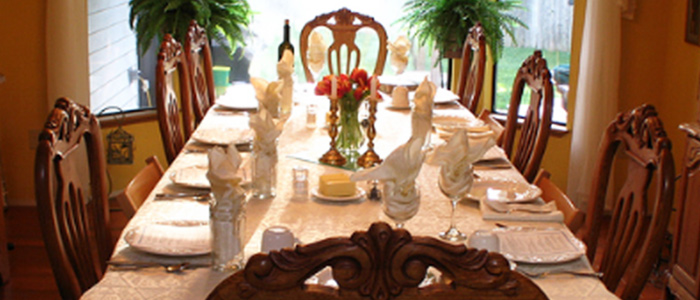
We sit at the Shabbat table, eating the dishes I prepared, the cake I baked, the mousse I whipped, all in the house I cleaned—but I am not the hostess here! On this day, the Almighty is the host!
What does this mean for us? We all try to make sure our Shabbat table is as it should be. Words of Torah, Shabbat songs… But I must admit, and perhaps this happens to you too… Things do not always go according to plan. Sometimes I may somehow suddenly end up on the sofa… Or snap at a child who spilled Coca-Cola on the clean floor… All sorts of things happen.
But I can guarantee that I will behave impeccably, will not get angry with anyone, and will listen attentively to the words of Torah spoken at the table if I am a guest in the home of an important person.
My older brother became the rabbi of Ofakim in my father's place. May the Almighty give him much strength; he does so much for the community… Once we were guests in his home. Besides us, there was a woman from the community, a widow with two children. She kept fidgeting as though on pins and needles, constantly shushing her children so they would behave properly, barely letting them breathe. I tried to tell her not to worry, pointing to my own children, who were running wild to their hearts' content. And suddenly, looking at her, I understood what it means to be a guest in the home of someone you deeply respect.
At our Shabbat table, we are not the hosts. The Almighty is the host. During the third meal, we sing, “This meal is for the Holy Ancient One”...
My father once asked what this means. We answered that the Almighty is present with us at the meal. My father said, “Incorrect! This is the Almighty's meal! It is incorrect to say that He is our guest! He is the host! And we are His guests.” And if the Almighty is the host, that means we will not simply do whatever we please.