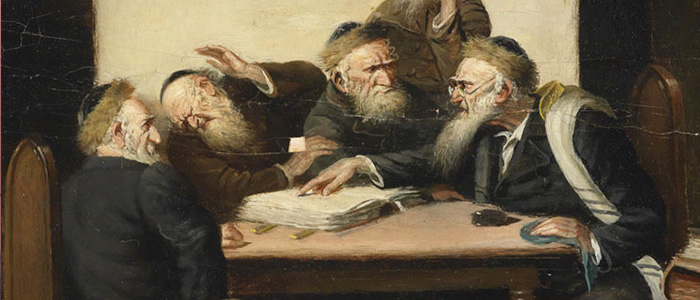
42. One who is engaged in Torah study must stand when he sees his teacher or another Torah scholar.
43. A sage or teacher should preferably take a route where as few people as possible will have to interrupt their activities and studies to stand for him.
44. If two people enter a shop and one of them is a person you know to be a Torah scholar or is your teacher, you must let him go ahead so that he is served first.
45. It is forbidden to treat sages with disdain, and all the more so to insult a sage. The Talmud states that a person who violates this prohibition cannot be cured of his illnesses and forfeits his share in the World to Come.
In fact, this involves violating several commandments at once:
1. He feels no awe for the sage and does not respect him (see Deuteronomy, 6:13);
2. He fails to fulfill the commandment “vehadarta penei zaken” (“You shall rise before the gray-haired and honor the elderly” (Leviticus, 19:32));
3. It is also said of him: “Devar Hashem bizah” (“He has scorned the word of God” (Numbers, 15:31)).
The Talmud says that Jerusalem was handed over to the enemy and destroyed only after people began treating Torah scholars with disdain, shaming and humiliating them in every way.
46. When a sage or teacher is insulted, one must not remain silent; one must express disagreement and disapproval.
*** It was the night of Simchat Torah. The whole town was taking part in the dancing and hakafot (circle dances with a Torah scroll). When it was already late and people were beginning to go home, Rabbi Yehoshua Leib Diskin called over the person in charge of the synagogue service and whispered something in his ear. The man listened to the rabbi, raised his head, and announced loudly: “We are starting the hakafot from the beginning.” Everyone took their previous places as though nothing had happened, and the cantor began to sing. When the repeated hakafot were over, everyone present could barely move their feet, but no one asked any questions. At last, people went home for the meal. The rabbi’s son, left alone with his father, asked him: - Father, what mistake was made in the first hakafot? Rabbi Yehoshua Leib answered briefly: - One of the Torah scholars did not receive the hakafah that was rightfully his[1].
[1] During a hakafah, selected people are given the honor of carrying a Torah scroll—this is called “receiving a hakafah.”