Rebbetzin Yemima Mizrahi
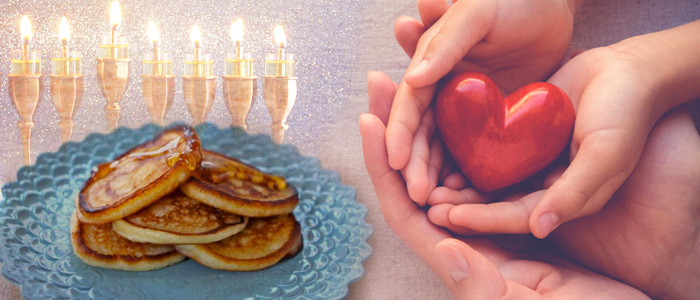
Why do we eat levivot (pancakes) on Hanukkah? To warm levavot (hearts).
One of the human qualities the Almighty values most is lev tov, a good heart. What is Greek philosophy? It is intellect, it is the brain. What is valued in the world today? Brains. Achievements, breakthroughs, startups. And people who have acquired a good heart? They are disregarded…
Where in the Tanakh do we see someone with a good heart, but… impulsive? It is Reuben, Jacob's son. When Joseph demands that Benjamin be brought to him in Egypt, Jacob replies that he will not let his youngest son go with them. Then Reuben jumps up and says: “If anything happens to Benjamin, you can kill two of my sons!” Jacob replies: “My son will not go down with you.” Reuben! What are you saying? Kill two grandsons for a son?! Reuben is impulsive; he thinks with his heart. There is a midrash about Rabbi Tarfon, who, during a lesson, would respond to a clever question by saying: “Kaftor vaferach,” meaning “clever, like the structure of the Menorah,” and to a foolish one: “My son will not go down with you”—an inappropriate, foolish question.
But Reuben is the only son who brings his mother flowers! Dudaim. And in doing so, he linked himself to Hanukkah. Who established the holiday of Hanukkah? The tribe of Issachar, the sages—bnei binah, “those who know the times.” “Bnei binah yemei shemonah kavu shir u-renanim” we sing in “Ma'oz Tzur.” They knew when to establish holidays for the Jewish people. But to whom does Issachar owe his birth? To Reuben, who brought his mother dudaim. For these dudaim, Rachel was willing to give up her turn to be with Jacob… And Reuben wanted to please his mother, because he had a good heart.
Hanukkah is…
Compensation
In addition, Hanukkah is a holiday of compensation. For whom? For each of us. For every woman who feels that the Almighty does not notice her work, does not reward her, does not give her what she deserves. Aaron the High Priest saw the gifts the tribal leaders were bringing—and grew sad that he could not bring gifts too. Light the Menorah? Wonderful. And that's all?.. No, in the future, a hanukkiah will be lit in honor of your descendants' victory.
The hanukkiah is lit at sunset or when the stars appear, and the stars are compensation for the moon because it made itself smaller than the sun! It was given the beginnings of the months (Rosh Chodesh) and companions—the stars.
Rabbi Nachman says some interesting and complex things about Hanukkah (“Etzot Mevo'arot,” Hanukkah, 4): “To the extent that each person merits to act on Yom Kippur, asking, ‘Please forgive,’ that is, to the extent that he merits to work before the Almighty for the forgiveness of his sins, he merits the holiness of Hanukkah, because the holiness of Hanukkah flows from forgiveness on the Day of Atonement.” What does this mean?
Gratitude for Goodness
Hanukkah is a holiday when we give thanks for what we have. For family, for work, for health. But a person finds it unpleasant to thank the Almighty (that is, to acknowledge the good done for him) when he feels impure from sin, stained—it means that we received all this goodness undeservedly. It is quite different when we have been cleansed on Yom Kippur and no longer carry the burden of sins—then we can look at our lives with gratitude. When a person is neatly and beautifully dressed, he feels confident and looks kindly upon others.
What did the Greeks do? Partzu chomot (migdalai)—they breached the walls. In Song of Songs it is written (8:10): “I am a wall.” The Jews had doors, and the Greeks broke them down—so that there would be no private life, no family, so that a wife would not wait for her husband but would be “open” to everyone. But on Hanukkah, we light candles by the door, in the doorway, to show that the Almighty did not give the Greeks power over Jewish women, that He gives us family, love, and His protection.
Teshuvah
The Baal Shem Tov says that the level a Jew can reach on Yom Kippur is lofty and unattainable, yet it is still not as high as the level any Jew, even the simplest, can reach on Hanukkah. Why? Because no holiday has a “home” in the Gemara. The Jews ate the Passover offering (sacrifice) on the roof of the house; on Sukkot, we live in a hut; Shavuot has its center in the house of study—in the synagogue, in the beit midrash. On Hanukkah, however, we light candles in the doorway of the home, and for that, a person must have a home. Hanukkah is a holiday when we can return to the Almighty—as we return home.
But we do not believe such teshuvah is possible. We do not believe that everything can be forgiven and forgotten—as though it had never happened. We are terribly afraid, our sins are great, everything will turn out badly—this, incidentally, is the work of the yetzer hara. “At the beginning of G-d's creation of heaven and earth—the earth was confusion and desolation, and darkness was over the abyss, and the breath of G-d hovered over the waters—and G-d said: Let there be light! And there was light.” Light is the twenty-fifth word in the Torah—just as Hanukkah begins on 25 Kislev. And what comes before that? Rabbi Shimon ben Lakish says: “These are the four exiles. Confusion is Babylon, desolation is Media, darkness is the Greeks, and the abyss is the Romans.” Babylonian confusion—we now have no place in the world, we are without our own land! Median emptiness—Haman wanted to kill us, and no one would have remained. Greek darkness—it plunges us into depression, makes us serve the Almighty without desire. And the Roman exile is an abyss. The Maharam of Rothenburg says that this exile contains elements of all the previous ones: confusion and having no place, danger to life, the darkness of depression, and the feeling that there is no end to it. We sing in “Maoz Tzur”: “Redemption is far from us, and there is no end to the days of suffering.” But in the end there will be light. Without fail.
Start at the End
The weekly Torah portions around Hanukkah tell us about Joseph. Joseph's whole story is filled with tears. His childhood ends when his own brothers throw him into a pit with snakes and scorpions—and sit down to eat! Then a caravan, then Egypt, the ordeal with Potiphar's wife, prison… Why do we not cry? Because we know that everything will end well. The same is true for each of us—everything will end in light; we simply do not yet know the ending of this story. In the weekly Torah portion Miketz, the bad begins to come to an end—mi-ketz, “from the end.” No language has such a word: “from the end.” The name Yosef contains both sof—“end”—and yosif—“will add.” The bad is not the end; this is where everything is only beginning. When I teach women who have cancer, I do not let them say “cholah sofanit,” terminally ill. Who told you that this is the end? Believe me—no, not me—believe Him: this is not the end—and give G-d a chance to help you.
Tragedy?
It was the Greeks who introduced into our thinking this enjoyment of the feeling of an ending—Greek tragedy. How does it work? Everything leads to a terrible end, and we wait for it with bated breath because it is… tragic! Joseph knows how to turn tragedy into a happy ending! Pharaoh has a frightening dream. Seven fat cows are eaten by seven thin cows—and the thin cows do not grow any fatter. Seven full ears of grain are swallowed by seven thin ones—and the thin ones did not grow any fuller! A nightmare! He summons the dream interpreters—and what do they tell him? Tragedy! You will have 7 daughters—and they will die. You will conquer 7 kingdoms—and lose them. Pharaoh does not believe them and sends them away; he senses that this is not it. And then comes Joseph: yes, there will be years of famine, but first there will be years of plenty, and if you prepare properly, everything will end well!
Our life can be like seven skinny, unattractive cows: marriage, children, work, health, financial well-being, appearance, an apartment—you cannot bear to look. But inside these unattractive cows are the seven good cows they swallowed! Try to see them! Take a candle—shine some light for yourself and find your way. Like Joseph. How does he do it? In the Jewish way. He does not look for tragedy, finds nothing appealing in it; there is nothing beautiful about gloom! He looks for a way out of the situation. Because he is a Jew.
The Greeks are always “anti”: Antiochus, Antigone.
I studied this tragedy by Sophocles for my bagrut (matriculation certificate), even learning passages by heart. It is a nightmare! Not only do they all die at the end, but before she dies (or is confined to a slow death by starvation), she gives such a long speech! Why? To prolong the suspense, so that we spend longer feeling horrified in the face of death.
This is not the Jewish way! Jews do not dread death in advance or find anything mesmerizing about it. Many people think that the most frightening thing is to fall ill and know that the illness is incurable. But Chani Weinroth (a woman who died of an aggressive form of cancer) thought that the most frightening thing was when children saw that their mother was not cheerful. That is what her daughter said. When she was handing out candy at the hospital to the patients sharing her mother's room, one of the patients said: “Thank you. And I want to wish you good health. Your mother has probably already taught you that this is the most important thing.” The girl replied: “My mother never said that health was the most important thing. She always said that the most important thing was joy.” I know many women who lived long lives, yet their children never saw them cheerful for a single day! We are learning to be an ima semecha (אמא שמחה)—a joyful mother, abbreviated to esh (אש), fire.
Prepared by Mrs. Zissi Skarzhinskaya