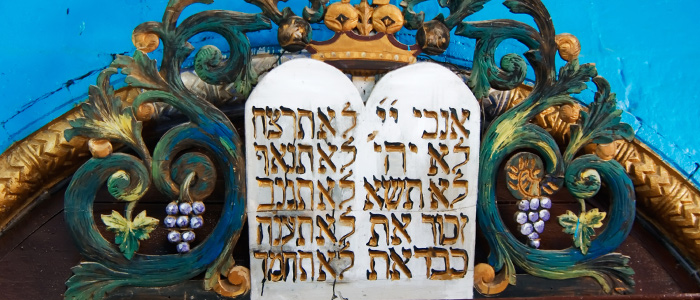
Honoring Father and Mother
The obligation to respect and honor one’s parents is a foundation of Jewish tradition. One of the Ten Commandments, given by the Almighty at Mount Sinai and inscribed on the Tablets of the Covenant, concerned precisely this.
The first five Commandments concern the relationship between a person and the Creator, and the commandment to honor one’s father and mother is among them. Those who honor their parents also honor the Creator. Since ancient times, it has been believed that true well-being and long life are found where people treat their parents and elders with respect.
1. It is written in the Torah: “Honor your father and mother, and the days of your life will be prolonged on the land that the Lord God gives you” (Shemot, 20:12), and also, “Fear (the Hebrew uses the word yirah, meaning ‘awe’) your mother and father” (Vayikra, 19:3). The Torah teaches us that parents should be treated with the same respect and honor as kings and rulers. In the presence of a king, a person feels fear and awe before his majesty, for their own life and the life of the entire nation depend on the king. By fulfilling the commandment “Honor your father and mother,” a person gains a special understanding of their connection with the Creator, who is also called “the Father and King of the universe.”
2. The Torah obligates a person to honor and help their parents not only because their parents brought them into this world, but also because everyone is obligated to remember the kindness shown to them. Helping one’s parents is therefore also regarded as repaying a debt.
This commandment belongs to the category of mitzvot whose meaning the human mind can grasp. It is one of the commandments that other nations, too, especially emphasize as a basis and foundation of their culture and proper social relations. It is also known that among other nations, too, it is customary to stand up in the presence of an elder or one’s parents.
The Talmud records an incident involving a non-Jew named Dama ben Netina, thereby showing the extent to which honoring parents was also widespread among other nations. Jewish sages came to Dama ben Netina to buy a precious stone for the High Priest’s breastplate. The key to the gem storeroom was under the pillow of ben Netina’s father, who was asleep at the time. The son was unwilling to wake his father to retrieve the key, even for a bag of gold that the sages offered.
3. Because this commandment belongs to the category of those “comprehensible to human reason,” no blessing was instituted for its performance. Nevertheless, it must be fulfilled like any other commandment of the Almighty, for in truth every commandment contains the subtle wisdom and light of the Creator, beyond all analysis and comparison. It is best when a person’s fulfillment of any commandment is motivated by love of God and pure faith.
4. This commandment is not limited by time, and there are no quantitative limits to its fulfillment. Therefore, anyone who strives to do as much as possible to help their parents and make them happy receives a great reward for this, both in this world and in the World to Come.
*** One day, the sons of the righteous Rabbi Yitzchak Soloveitchik were at his home, telling amusing stories to entertain everyone present. When their father entered, all the smiles suddenly vanished, and those present stood up with awe in their eyes. Their father noticed how abruptly everything had changed and said jokingly: “When Av arrives, joy and merriment diminish” (a play on words: “Av” means “father” in Hebrew and is also the name of the 5th month, which Jews associate with mourning over the destruction of the Temple).