Honoring Father and Mother
62. There are times when a person must choose between the mitzvah of honoring one’s parents and another mitzvah, such as burying or escorting the deceased. If there is no one nearby who can attend to the deceased, and his father (parents) has asked him, for example, to fetch some water, he should first attend to the deceased, since both father and son are bound by Divine law. (According to Torah law, the body must be buried that same day.) If, however, someone else can be asked to perform this mitzvah, one should first fulfill the parents’ request.
Here we were discussing a mitzvah that cannot be postponed, that is, a mitzvah overet (a mitzvah whose opportunity will pass). If, however, the other mitzvah places no time constraints on him and he can do everything necessary later, the son should first help his father.
What if the son has already begun attending to the deceased, and only then does his father ask him to fetch some water? In that case, the son may finish the task and bury the deceased.
63. If a father asks his son for help while the son is studying Torah, he must interrupt his studies and help his father.
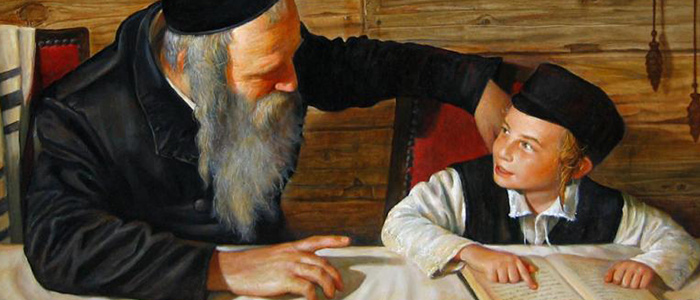
64. A father is obligated to pass on Torah knowledge to his son. He may teach him himself or hire a melamed (teacher). Since the father must also devote time to Torah study, if there is only enough money to pay for one of them to study, the question arises as to who takes precedence. In practice, however, this question becomes relevant only if the father and son have equal abilities. According to halachah, in such a case the father may not give up his own studies for his son's sake and devote all the money (earmarked for his own studies) and all his free time to his son's education.
If a father sees that his son is very gifted and surpasses him in ability, he is obligated to devote more time (and money) to his son's education. This does not exempt the father from his own obligation to study.
65. Although the Torah places particular emphasis on the commandment to honor one's parents, a son is permitted to leave for another city in order to continue studying Torah in his familiar place and with his own teacher. This is because, in a certain sense, the commandment to study Torah is considered more important: diligent study increases wisdom and peace on earth and keeps the chain of transmitting knowledge from one generation to the next unbroken.
If a son studies and lives in the same city as his parents, he must keep visiting them and caring for them.
After Menashe graduated with honors from school in Philadelphia, he devoted himself to studying Jewish traditions and laws. After spending two years in a yeshiva, he decided to go to Israel, to the Mir Yeshiva—one of Jerusalem's prestigious yeshivas. When his parents learned of his wish to leave for Eretz Yisrael, they became very anxious and could find no peace. What frightened his elderly parents most was the political situation in the Middle East. News reports and accounts of terrorist attacks and rocket fire came flooding back to them. Troubled by his decision, the parents approached their young Menashe's teacher and rabbi. He answered as follows: "If Menashe feels that he can make good progress in his studies specifically at the Mir Yeshiva, and you do not need any special help from him, halachah permits him to go there even if you disagree, because his spiritual development is at stake. I therefore recommend that you refrain from showing your displeasure and instead support your son in every way, to avoid conflict and preserve a good relationship."