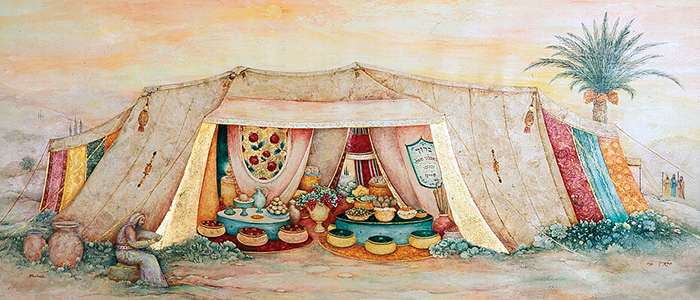
13. A woman can also fulfill the mitzvah of “welcoming guests,” but she must avoid unnecessary conversation and violations of yichud (the prohibition against a man and a woman being alone together), especially if she is unmarried or her husband is out of town. She must conduct herself with the utmost modesty. A woman should also not go out into the street to distribute food to the poor; she can fulfill this mitzvah near her home as well.
14. It is not customary for a woman to drink strong alcoholic beverages in company. Even if her husband allows her to drink wine and other alcoholic beverages at home, she should refrain from doing so when visiting others.
15. One should not invite unworthy people into one's home.
16. In the past, when the Temple stood, a Jew could bring sacrifices and atone for his sins. But since the destruction of the Temple, the table at which we eat is like an altar that purifies us. And if Torah scholars sit at it, the meal is considered equivalent to a sacrifice (when the Almighty accepted the offerings placed on the altar).
17. One must not say to a guest, “Come in and eat with me, since I once ate at your home,” so that it does not look like repayment of a debt. For if it is seen as repayment of a debt, there is an issue of ribbit (interest): if the guest eats more, it is akin to repaying a debt with interest. But one may say to someone, “First eat with me, and another time I will come to visit you,” regardless of how much each person eats.