The prohibition against shaming and insulting (halbanat panim)
1. “Kavod habriyot” (respect for human dignity) is given a central place in Judaism.
For example, certain rabbinic enactments do not apply in matters of hygiene and basic human needs, or in a situation where observing such an enactment could lead to humiliation or cause a feeling of shame.
Examples:
a) On Shabbat, it is not forbidden to return home wearing a tallit with torn tzitzit strings if one is walking through a “karmelit” (the Sages did not require him to remove it in public).
(A karmelit is, for example, a sea or a valley, as well as areas adjacent to a public domain through which large numbers of people do not pass. The status of this domain differs from that of both a private domain and a public domain. The Sages prohibited carrying anything out of a karmelit into either a private or a public domain, as well as carrying anything into a karmelit from either a public or a private domain. They also prohibited carrying any object a distance of 4 cubits within a karmelit, just as in a public domain).
b) If, on Shabbat, a person discovers that he is wearing a garment containing “kilayim,” meaning linen and wool together, which is forbidden by Torah law, he may return home without removing it. (However, this permission applies only if it is “kilayim d’rabbanan”—kilayim as defined by the Sages.)
c) On Shabbat, carrying smooth stones is not prohibited (in ancient times, smooth, round stones were used instead of toilet paper).
What prompted the great Rav Yisrael Salanter to establish an entire organization whose goal was to introduce special lessons in mussar into educational institutions[1]?
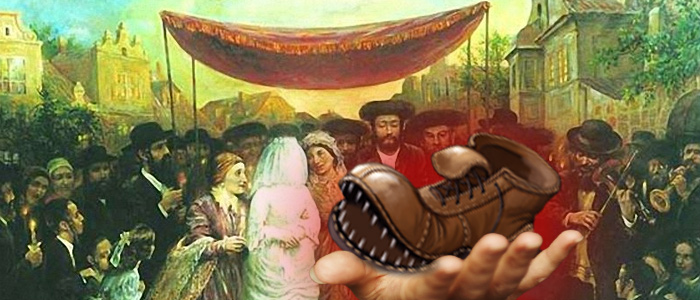
There once was an ordinary Jew. He was a cobbler, but fortune smiled on him, and he became wealthy very quickly. When he arranged his son's wedding, he chose the most prestigious venue in the city center for the ceremony, a place reserved for the upper classes. The local “aristocracy” was very displeased with this audacity. One of the wealthy men decided to remind the former cobbler of his proper place. He approached him during the chuppah[2] with a torn boot in his hand and asked, “How much would it cost to mend this?” When Rabbi Yisrael witnessed such an appalling display of bad character, he decided to devote himself in earnest to spreading mussar.
**** In Jerusalem, it was customary for one of the rabbis to give a lesson on Shabbat before sunset. Sometimes the lesson ran late and ended after sunset, so everyone tried to recite the afternoon prayer, Minchah, as early as possible. Once, Rabbi Berl Kroizer came to the lesson. He had not yet had a chance to recite Minchah. When he saw that it was growing dark and the lesson was not ending, he decided to leave. However, he did not want to disturb the speaker or show him disrespect, so he decided to move slowly and unobtrusively. The next day, he went to the Chazon Ish with a question: what would have been the right thing to do in such a situation?
Without hesitating, the Chazon Ish replied, “I don't understand the question! Showing disrespect to a Torah scholar and hurting him is a terrible transgression. Of course, you should not have left.”
[1] The study of morality and Jewish ethics.
[2] A chuppah is a wedding canopy. The word also refers to the wedding ceremony itself.