Rabbi Chaim Pinchas Scheinberg
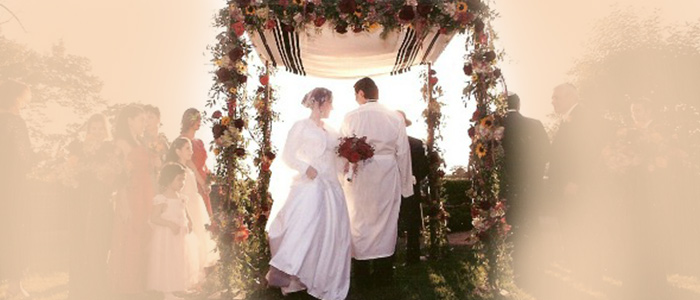
Among the many blessings, which the Sages included in the wedding ceremony, is the blessing "Yotzer ha'adam" (Who formed man). It speaks of the Almighty's creation of man. We find it very significant that the Sages chose to draw our attention to G-d's creation of man precisely at the time of marriage, rather than at birth.
Marriage comes several decades after birth. Why, then, do we wait so long to acknowledge and thank the Almighty for His chesed?
Clearly, the Sages considered a wedding the most fitting time to express our gratitude to the Almighty for creating man. Divine creation is so closely tied to the union of a man and a woman that during Sheva Brachot the blessing "Yotzer ha'adam" is repeated twice!
Moreover, according to some commentaries, the reason we recite the blessing “yotzer ha’adam” twice under the chuppah is that we need to mention Chava’s creation. The first blessing refers to Adam’s creation, and the second to Chava’s creation. It is highly significant that we mention each moment of Creation separately by reciting two distinct blessings.
These two blessings help us understand the great wisdom the Almighty demonstrated by creating Chava from Adam, whom He had already created. The midrash “Yalkut Shimoni” (Bereishit) describes how the Almighty considered many possibilities before deciding which part to create Chava from: the head, eye, ear, mouth, heart, hand, or foot.
The Almighty ultimately decided to create Chava from Adam’s side so that she would be modest by nature. The arms cover the sides, so of all the parts of the body, Adam’s side was best suited to embodying Chava’s essence.
Modesty is much more than a style of dress. Modesty is much more than a way of behaving.
Tzniut is so precious that it is inherent even in the Shechinah. “Midrash Tanchuma” (Bamidbar, 3) points out that upon the dedication of the Mishkan (the portable Sanctuary), the Almighty praised the virtue of modesty. With the completion of the Mishkan, the Almighty could speak with Moshe Rabbeinu in the privacy of the Mishkan.
Tzniut is very important in married life, for both husband and wife. It is essential to fulfilling their purpose in life. Moreover, it is necessary for life itself. The Almighty created women with an innate ability to be within the home. This gives the home a powerful spiritual foundation, which in turn helps the man fulfill his purpose.
The quality of tzniut is the foundation of a woman’s essence and applies to every aspect of life. Tzniut helps a woman fulfill her purpose in life.
Tzniut is also an important quality for a man. In the sixth chapter of tractate Avot, Rabbi Meir teaches: “One who studies Torah lishmah (for the sake of Heaven) merits many things. Moreover, the entire world is worth it.” Rabbi Meir then lists many blessings, among them tzniut.
Moreover, tzniut is an obligation for a talmid chacham (Torah scholar). “Yalkut Shimoni” (Ki Tisa) says: “A talmid chacham must be tzanua (modest), like a kallah (bride).” Tzniut, as the wife’s inner essence, is the pinnacle of the husband’s perfection.
Tzniut—the gift the Almighty originally gave to a woman—can also be acquired by a man, but only at the cost of great effort.
After many years of married life and great effort in Torah study (Torah lishmah) —the groom will attain the virtues his bride possessed from the outset.
The blessing “yotzer ha’adam” is most appropriate under the chuppah rather than at birth because what it expresses begins to be actively realized with the start of married life.
The word Adam, as pronounced in the blessing “yotzer ha’adam,” includes the definite article, which means “that very one, the one and only.” The use of this article usually indicates something special and unique. The Almighty created Adam to fulfill a clear and unique mission in life. More than any other creature, Adam knew his purpose in life: to perfect his spiritual qualities.
The verse (Bereishit, 2:20) describes how, after searching among all the creatures, Adam found no one who could help him fulfill his mission in the world. The Almighty therefore created Chava.
The creation of Chava—the perfect ezer kenegdo (“a helper opposite him”)—was the final, most important act of Creation, necessary for Adam’s perfection and completeness.
The first man knew better than anyone who ever lived how incomplete he was without Chava in his ability to fulfill his own purpose. Adam knew that Chava was his one and only wife in life, and the same can be said of Chava. They had no other possible options.
Our attitude toward our spouse should be the same. We may mistakenly believe that we have many options to choose from. Yet we must not be deceived by the apparent wealth of choices the vast world offers us. Our spouse is as unique, beloved, and irreplaceable as Adam was to Chava and Chava was to Adam.
The chuppah is the beginning of a journey together. There is no other man. There is no other woman. The groom, the bride, and everyone present affirm this very fact under the chuppah by saying “amen”.
After the chuppah, husband and wife walk through life together, discovering who each of them truly is. Married life is an opportunity the Almighty gives us to express our tzelem Elokim.
We conclude the wedding ceremony with a blessing in which we wish the newlyweds sasson, simchah, gilah, rinah, ditzah, chedvah, ahavah, achvah, shalom, and re’ut. These expressions of joy and delight set the tone for the beautiful, wonderful life the newlyweds hope to live together.
We repeat this blessing many times during the week of sheva brachot. This repetition reinforces the decision the chatan and kallah made together. During this time, something has changed. The chatan and kallah have taken on new roles. They have become husband and wife.
Mutual respect and admiration will develop out of a mutual recognition of each spouse’s role in building a Torah home, together with a clear understanding of the importance of the Torah home itself to the community of Israel.