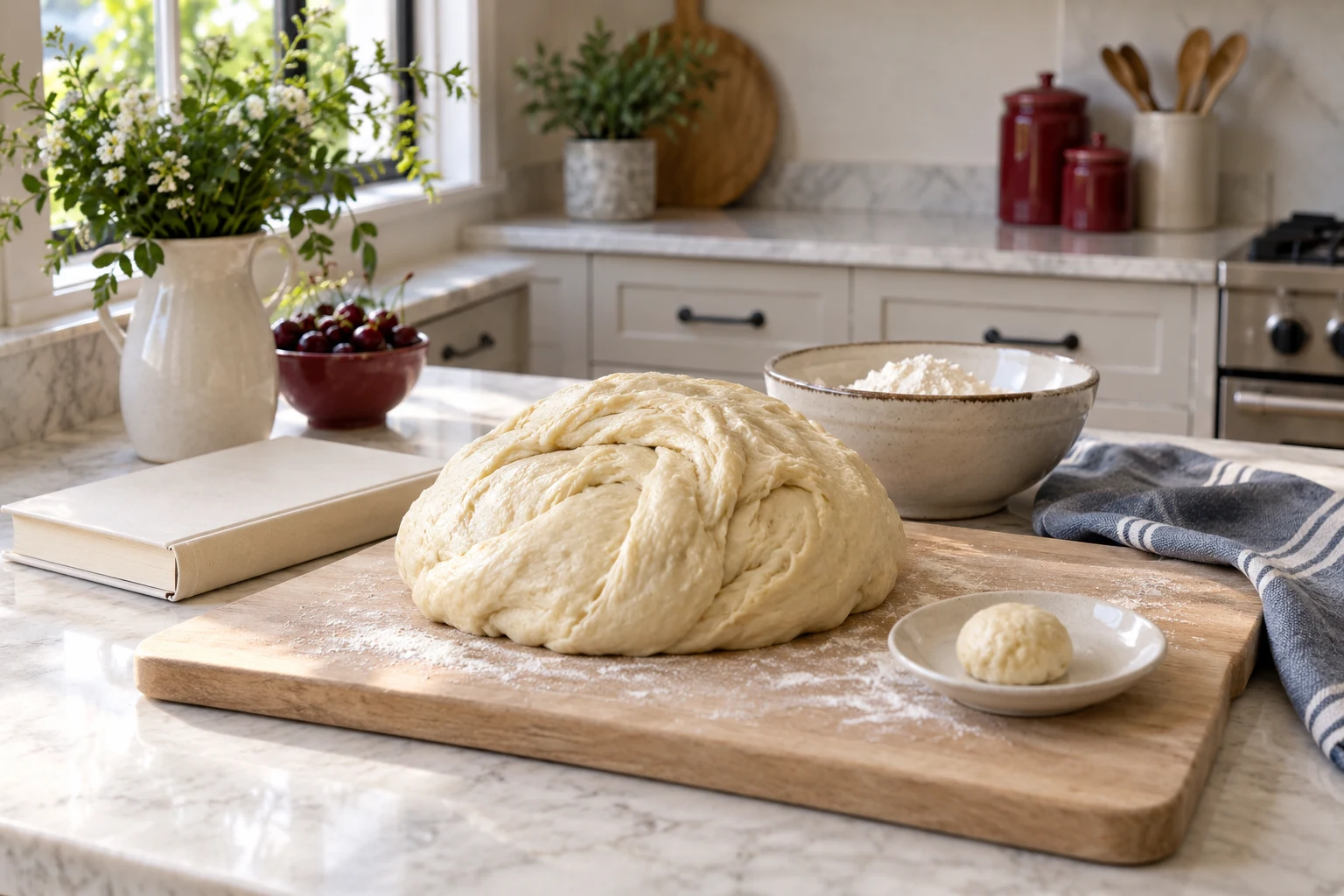
“From the first of your dough, you shall set aside a loaf of bread as an offering; just as you set aside an offering from the threshing floor, so shall you set this aside. From the first of your dough, you shall give the L-rd an offering throughout your generations” (Numbers, 15:20-21).
Introduction
The mitzvah of separating challah is the commandment to set aside a small piece of dough that belongs to a Jew and is made from one of the five types of grain: wheat, barley, spelt, oats, and rye. This piece is called challah. According to the law, challah must be given to a kohen (priest), and only a kohen may eat bread baked from it, provided that both he and the challah are ritually pure. This is what Jews did when the laws of ritual purity were observed. Today, when this is not possible and all of us, including kohanim, are ritually impure, the challah is burned. It is forbidden to eat dough from which challah has not been separated, or anything made from it—not only bread, but cookies and cakes as well.
1. Who Is Obligated to Separate Challah?
The mitzvah of separating challah from dough is binding on every Jew, but the primary responsibility for fulfilling it rests with the woman who runs the household. If a woman is unable to fulfill this mitzvah, any adult may separate challah on her behalf. If a child separates it, the separation is invalid.
2. From What Quantity of Dough Is Challah Separated?
The obligation to recite a blessing when separating challah from dough and to carry out the separation depends on a number of conditions.
A. A blessing is recited when separating challah if all of the following conditions are met:
· The dough is made with 2,250 kg of flour or more[1]. · The dough is mixed with water, olive oil, bee honey, milk, or wine. · All or part of the dough will be baked in an oven or cooked in a frying pan without adding liquid.
B. Challah is separated without a blessing in the following cases:
· More than 1,200 kg of flour, but less than 2,250 kg, was used to make the dough[1]. · The dough is mixed without using water, olive oil, bee honey, milk, or wine.
C. Challah is not separated in the following cases:
· Less than 1,200 kg of flour was used to make the dough. · All the dough is intended exclusively for boiling or deep-frying (for example, for dumplings or doughnuts). Some separate challah in this case as well, but without a blessing.
If part of the dough (even the smaller portion) is baked or cooked in a frying pan, challah must be separated from all the dough. If the conditions listed in section A are met, a blessing must be recited when separating challah.
3. When Is Challah Separated?
Challah is separated from firm dough before baking, and from batter after baking. If challah was not separated from firm dough before baking, it must be separated afterward.
Separating challah is forbidden on Shabbat. If one forgot to separate challah before Shabbat, a portion of the baked goods (somewhat larger than the amount usually separated—see section 4) is set aside until after Shabbat, and challah is then separated from that portion. The rest may be eaten on Shabbat. However, this rule applies only to dough kneaded outside Eretz Yisrael.
If the dough was prepared in Eretz Yisrael and challah was not separated from it before Shabbat, the goods baked from it may not be eaten on Shabbat, and challah must be separated after Shabbat.
This law also applies on Yom Tov if the dough was kneaded on a weekday. If the dough was kneaded on the festival itself, challah is separated that same day (even in Eretz Yisrael), but the separated portion is burned after Yom Tov ends (see section 4).
4. How Is Challah Separated?
The piece of dough separated as challah should be approximately the size of half an egg. When a blessing is required (see section 2), the following is recited:
בָּרוּךְ אַתָּה יְיָ אֱלֹהֵינוּ מֶלֶךְ הָעוֹלָם אֲשֶׁר קִדְּשָׁנוּ בְּמִצְוֹתָיו וְצִוָּנוּ לְהַפְרִישׁ חַלָּה.
Baruch Atah Ado-nai Eloheinu Melech ha-olam asher kidshanu bemitzvotav vetzivanu lehafrish challah
Blessed are You, L-rd our G-d, King of the universe, who has sanctified us with His commandments and commanded us to separate challah.
Then say, “Let this be challah,” and, after separating the challah, burn it or wrap it carefully and place it in the trash.
5. Combining Several Batches of Dough
When there are several batches of the same type of dough (or baked goods) whose flour content reaches the amount required for separating challah only when combined, they must be joined together. To do this, put all the batches (or all the baked goods—see section 3) in a single container or, for example, on a tablecloth, covering them with that same cloth, and separate challah after reciting a blessing.
In the same situation, if the portions of dough or baked goods, whose individual flour quantities do not reach the amount required for separating challah, are made from different kinds of dough, consult a rabbi.
6. Challah Fell into the Dough
If, after being separated, the challah falls into the dough and becomes mixed with it, a rabbi must be consulted.
[1] Some recite a blessing when separating challah from dough made with 1,666 kg of flour or more.