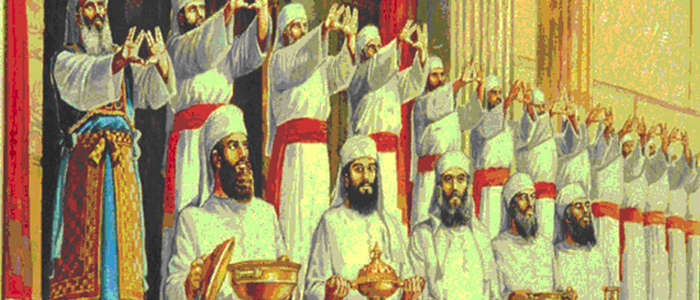
Treatment of Kohanim and Levites [1]
Kohanim have always been responsible for the Temple service. As early as Aaron's time, a special consecration ritual was performed, after which each kohen, by virtue of his special sanctity, took on particular restrictions while also receiving many privileges. Even today, when there is no Temple, a kohen is called to the Torah first and is given precedence in reciting blessings, choosing the best portion when property is divided, and so on.
1. Every Jew has a mitzvah to honor kohanim, as the Torah says concerning kohanim: “And you shall sanctify him, for he offers the bread of your G-d (as a sacrifice); he shall be holy to you, for I, the Lord Who sanctifies you, am holy” (“Leviticus,” 21:8).
This must be expressed not only through actions but also through words. In all matters concerning Torah and holiness, kohanim have the right of precedence. Therefore, before any special ceremony or the recitation of blessings (for example, at a wedding or a brit milah), one should always find out whether a kohen is present and, if so, accord him the appropriate honor.
2. Even a kohen who has sustained a physical injury and therefore cannot serve in the Temple does not lose his special status. He, too, must therefore be treated with respect. The only question concerns very young kohanim (under 13 years old). The Sages of later generations disagreed on this point, so anyone wishing to avoid uncertainty should show special respect to young kohanim as well.
3. A kohen who marries a woman forbidden to him loses his former sanctity and, accordingly, all the privileges of a kohen. He can return to the service only after divorcing her and repenting fully.
4. If a person finds two items on the street, one belonging to a kohen and the other to a Levite, the item lost by the kohen should be returned first.
In such a case, the kohen comes first, the Levite second, the Yisrael (an ordinary Jew) third, and the mamzer last (someone born of a forbidden union—for example, a child born to a married woman by a man other than her husband). The same applies to the mitzvot of redeeming captives and giving tzedakah.
Likewise, a kohen must be given precedence in reciting the blessings before and after a meal, and in the absence of a kohen, a Levite has precedence over a Yisrael. But this hierarchy applies only when they are equal in Torah knowledge. If the kohen is unlearned and the other person is a mamzer but a Torah scholar, the situation changes fundamentally: in that case, the mamzer who is a Torah scholar has first priority.
[1] The descendants of the tribe of Levi were chosen for service in the Temple, with the most important part of the service, involving korbanot (known as sacrifices), assigned to the kohanim—the priests, descendants of Aaron, Moses' brother. The Torah requires kohanim to observe special rules of holiness.