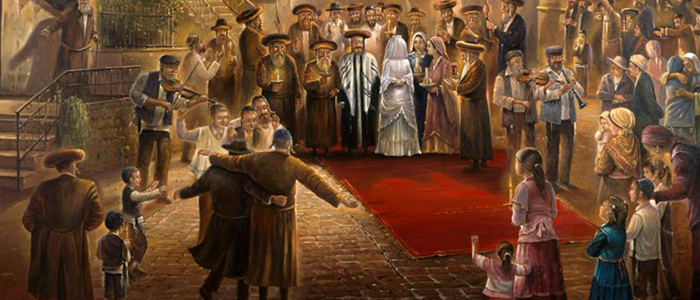
Bride and Groom
7. Although dancing before the bride is a great mitzvah, many authorities on Torah law do not permit a man to dance with the bride, even when this means that the man holds one end of a long scarf and the bride holds the other. However, if a person does this for the sake of the mitzvah, observing all the rules of modesty, the law does not require stopping him.
A man is also forbidden to gaze intently at the bride.
8. Although it is a mitzvah to bring joy to the bride and groom, the wedding celebration must not turn into a party where people begin behaving frivolously and without restraint. Care must be taken to ensure that the men remain on their side and the women on theirs (during the dancing and the wedding meal). The Sages write that a meal at which men and women sit together without any separation is no longer considered a mitzvah or a sacred occasion, regardless of why it was arranged. Such situations have often led to open socializing between men and women and violations of the Torah's commandments.
9. A father has a mitzvah to help his son or daughter arrange a wedding. It is even permissible to accept donations for this purpose.
10. Finding a suitable match for a man or woman is considered a great mitzvah. The same applies to any help with arranging the wedding and to providing the young couple with financial support for the essentials of their future life together (clothing, housing, dishes, furniture, etc.). If a person is very poor, he should be helped to obtain everything necessary for family life, or even have an apartment rented for him, before turning to the matter of arranging the wedding.
If money remains in the synagogue treasury or in designated charitable funds, the best use of it is to help poor girls with their wedding preparations. If the community does not have enough money to help orphans with wedding preparations, it is permissible to sell a synagogue, a Torah scroll and other sacred items for this purpose.
*** Once, the Vilna Gaon received a letter from a Jew in the small town of Keidan, describing his problems and suffering. He had ten daughters, and his eldest had long been of marriageable age, but he had no money at all to help her. He knew no one in Vilnius, so he turned to the Vilna Gaon.
At the time, the great Sage did not have enough money even to feed his own children, but he undertook the difficult task of raising the necessary sum for this Jew with extraordinary zeal. Ultimately, thanks to his efforts, all the daughters were happily married.